
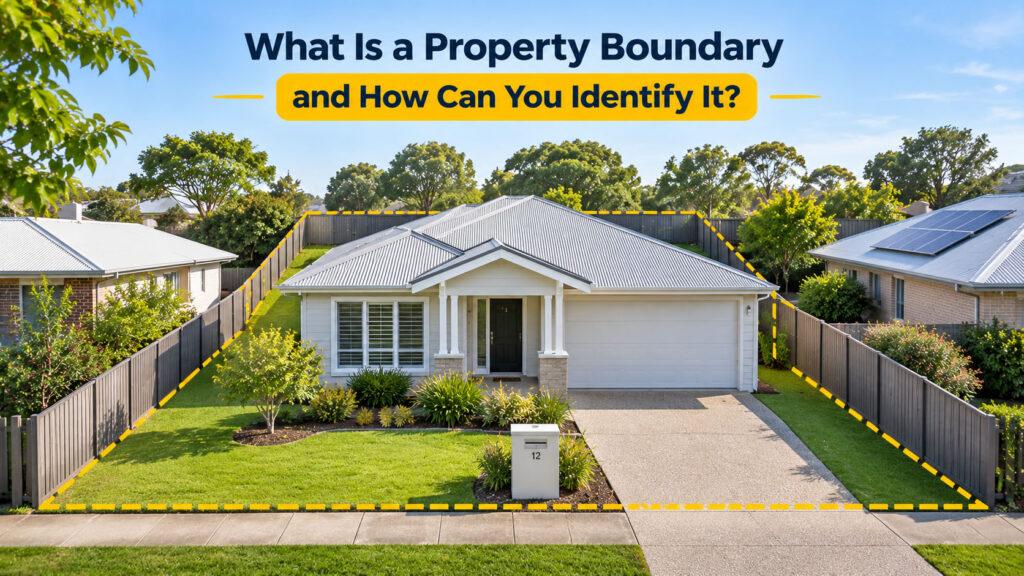
Say you’re planning to replace the old side fence. It was there when you bought the house, so you’ve always assumed it sits on your boundary. Then the fencing contractor asks if you’ve confirmed where the boundary actually is, and you realise you’ve never checked.
It’s an easy assumption to make. A fence is the most visible thing on most blocks, so people treat it as the edge of their land. A property boundary is something different. In Queensland it’s recorded through survey plans and marked on the ground by survey marks, and a fence may or may not follow it. This guide explains what a property boundary is, how you can start identifying yours, and when it’s worth calling in a surveyor before you build, plant or dig.
What Is a Property Boundary?
A property boundary is the legal edge of your land parcel. It’s the line that separates your lot from neighbouring lots, the road or other land. Each lot in Queensland is described on a registered survey plan, which records the lot’s boundaries and area, and your certificate of title refers to the current plan for your lot.
On the ground, boundaries are marked by survey marks, most commonly a white peg at each corner. Business Queensland explains that Queensland boundaries are defined by these marks, not by GPS points or coordinates. So the boundary is a legal line, set out on a plan and found on the ground by a surveyor. It isn’t a hedge, a fence or the edge of the lawn that happens to look right.
If you own a townhouse or unit, the picture is a little different, because parts of the complex are shared. Our guide to what a body corporate actually covers is a useful starting point.
Why Property Boundaries Matter to Homeowners
Most people never think about their boundaries until something prompts it. These are the usual triggers:
- Buying or selling. If you’re buying a property, knowing what the lot actually includes, and whether anything crosses the line, helps you avoid surprises after settlement.
- Fences and retaining walls. Where these go, and who is responsible for them, depends on where the boundary is.
- Extensions, sheds, pools and driveways. Structures near a boundary can be affected by setback rules and by easements.
- Landscaping and trees. Garden beds, edging and large plantings are often placed by eye, using the fence as a guide.
- Neighbour relations. Dividing fences are a common source of disagreement between neighbours, and a lot of that comes from nobody being sure where the line is.
Does a Fence Always Mark the Property Boundary?
No. Plenty of fences do sit on or very near the boundary, but a fence’s position is not, by itself, proof of where the legal boundary is.
Fences get built, repaired and replaced over many years, often by previous owners and often without a survey. Neighbours sometimes agree informally on where a fence should go, and later owners never hear about it. A fence may also have been placed to suit the slope, a tree or a retaining wall rather than the exact line. Once a fence has been standing for decades, everyone tends to treat it as the boundary.
The Queensland Government’s advice is straightforward: to find out whether a fence is built along the common boundary, engage a registered cadastral surveyor to carry out an identification survey.
How Can You Identify Your Property Boundary?
You can do some useful research yourself before paying for anything. Just treat it as preparation, not confirmation.
Check Your Property Title and Survey Plan
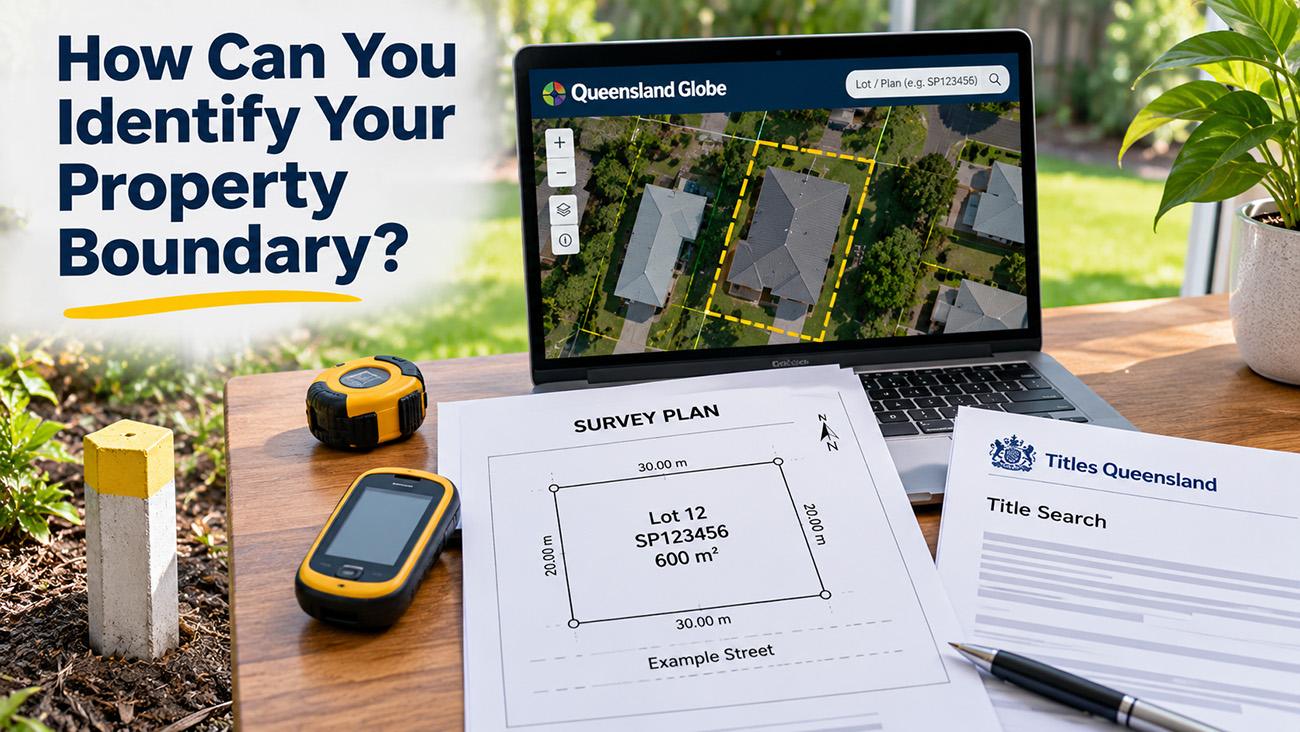
Start with your lot and plan details, for example “Lot 12 on SP123456”. You’ll find them on your rates notice, on your title or through online mapping tools. With those details you can order your survey plan and a title search from Titles Queensland. The plan can be ordered online through Online Title and Image Searches.
A survey plan shows the lot identifiers, adjoining lots, bearings, distances and area. Some things it doesn’t show:
- It doesn’t show the distance from the kerb to the boundary, so you can’t find your boundary by measuring from the kerb.
- It generally doesn’t show buildings, unless the property is a building unit.
- A current plan may not show easements, leases or covenants, because those can be created by a different plan. A title search is where you check for those.
Older plans can also use imperial measurements, old street names and other conventions, which makes them harder to read. If you’re buying, the contract is worth reading closely too, and our guide to understanding real estate contracts covers the fine print. Turning a plan’s bearings and distances into a line on the ground is surveyor’s work, so use these documents to get oriented, not to mark out a fence.
Use Government Mapping and Property Records
The Queensland Globe is a free interactive map that lets you view your lot, neighbouring parcels and details like lot and plan number, area and local government. Your council’s website may also have property mapping.
These tools are handy for orientation, but they have limits. The government says the Globe is not the point of truth for parcel boundaries and that the lines it draws don’t represent the true boundaries on the ground. The registered survey plan is the legal source of truth. So don’t take a boundary off a screen, or a phone’s GPS, and put a fence post there.
Look for Survey Pegs or Boundary Markers
Cadastral survey marks are most commonly white pegs, often with a reference mark nearby such as a buried iron pin or a nail in the kerb. If you can find them, they can help show where the corners are.
But finding them isn’t always possible, and finding one isn’t always enough. Marks can be disturbed or removed by construction, footpath and driveway upgrades, utility work, kerb restoration, vegetation clearing and landscaping. A peg-like object might not be a survey mark at all, and one that has been knocked or moved can mislead you. Without confirmation from a surveyor, don’t rely on a peg you’ve found.
Please don’t pull one out either. Under the Survey and Mapping Infrastructure Act 2003, interfering with a survey mark without approval is an offence, and Business Queensland advises that cadastral marks should only be removed for building a fence or structure on the boundary, or by a registered surveyor.
Hire a Registered Cadastral Surveyor
When you need certainty, a surveyor is the right call. In Queensland, only surveyors registered with the Surveyors Board of Queensland can carry out cadastral surveys. The survey that marks an existing boundary is called an identification survey. It’s a different job from a building certifier approving construction, and different again from a contour or site survey, which records features on the land and isn’t meant to define boundaries.
Defining a boundary can be complex. The surveyor has to weigh all the legal and physical evidence, then prepares a plan and lodges it with the Queensland Government as an official record. If your land hasn’t been surveyed recently and the pegs are gone, they can re-mark the boundary. A surveyor is worth considering when:
- you’re building or replacing a fence, or building close to the boundary
- you’re planning an extension or renovation near the line
- the boundary is unclear, or pegs are missing or disturbed
- you and a neighbour disagree about where the boundary is
- something appears to cross the boundary
One more thing worth knowing. Surveyors are required to notify landholders who may be affected when a boundary is reinstated, including where there are improvements on, near or over it. According to Business Queensland, that notification is a written record to advise, not a demand to fix anything.
Property Boundary vs Fence Line vs Easement
These three get mixed up a lot, so here they are side by side.
Property boundary. The legal edge of your lot, recorded on the registered survey plan and marked by survey marks.
Fence line. Where a fence physically stands. It might match the boundary closely, or it might not.
Easement. A right for someone else, such as a council or utility provider, to use part of your land for a specific purpose, like a drainage pipe. You still own the land and the boundary doesn’t change, but what you can build or plant on that strip may be limited. Easements are shown on the title, and the Queensland Government notes that a current survey plan may not show them, so check a title search as well.
For example, your boundary might run along the back fence, but a drainage easement could cover the strip along one side of the lot. The land is still yours, yet a shed or retaining wall there could cause problems.
What Should You Check Before Building Near a Property Boundary?
These are the checks I’d work through first. Requirements vary with the type of work and the property, so treat this as a prompt rather than a rule book.
- Confirm the boundary. Don’t build from an existing fence or a neighbour’s structure. A surveyor can confirm the line, and Business Queensland suggests considering a search of the construction area to see whether survey marks are at risk of being disturbed.
- Check your title and plan for easements, covenants and other restrictions. The City of Gold Coast notes that title restrictions and earlier development approval conditions can limit fencing, even for later owners.
- Check council requirements. The City of Gold Coast says property fencing up to 2.0 metres above original ground level usually doesn’t need building approval, with exceptions including corner lots, swimming pool fencing, waterfront fencing and title or approval conditions. Its retaining wall rules are separate.
- Check pool fencing rules if the fence will form part of a pool barrier, because the Queensland Government has separate notice requirements for that.
- Talk to your neighbour first. The Neighbourhood Disputes (Dividing Fences and Trees) Act 2011 sets out a process for asking a neighbour to contribute to fencing work, and the Queensland Government’s fence owner guide is a good overview. Retaining walls aren’t classed as fences under that Act.
- Get professional advice where needed. A building designer, engineer or private building certifier can help with approvals. Council also suggests checking for underground services and considering whether an old fence might contain asbestos before it comes down.
What Happens If You and Your Neighbour Disagree About a Boundary?
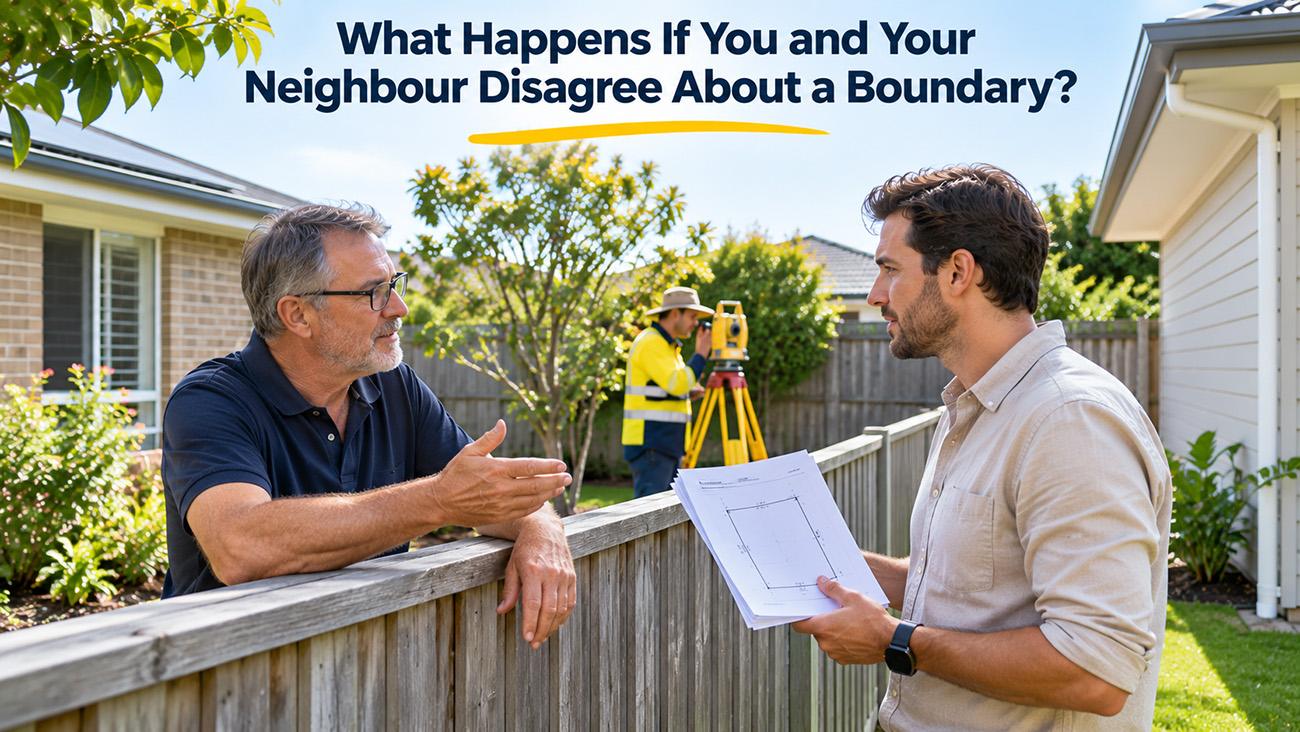
Start calmly and stick to facts. Many disagreements come from honest assumptions on both sides, and they ease once the documents are on the table.
- Talk first. Explain what you’ve found and ask what they understand the boundary to be.
- Compare documents. Look at each other’s survey plans and title details instead of arguing about where the fence has always been.
- Get a survey. Business Queensland notes that adjoining owners may engage an independent registered cadastral surveyor to identify the exact location of the boundary.
- Use dispute resolution if needed. The Queensland Government says disputes between neighbours need to be settled through dispute resolution, mediation or other available remedies, and it points people to the Queensland Civil and Administrative Tribunal (QCAT) for dividing fence disputes. It describes QCAT as a last resort.
- Get legal advice if you think a surveyor has made an error, or if the dispute involves something like a retaining wall that can’t be settled between you.
Common Mistakes Property Owners Make When Identifying Boundaries
- Assuming the fence is the boundary. It might be. It’s not proof.
- Relying on online maps alone. They’re a starting point, and the government says they aren’t the point of truth.
- Measuring from the kerb or a neighbour’s fence. The survey plan doesn’t give kerb-to-boundary measurements.
- Trusting old pegs. Marks get moved and removed over time.
- Building first and checking later. It’s much cheaper to find a problem before the concrete is poured.
- Overlooking easements. They can restrict what you build even when the boundary is clear.
- Relying on informal agreements. What you agreed with a neighbour may not bind the next owner, so it’s worth getting advice before treating it as settled.
- Confusing a building inspection with a boundary check. A building and pest inspection looks at the condition of a home, not where its boundaries sit.
- Assuming long ownership means the boundary is obvious. Years of living somewhere doesn’t change what the plan says.
A Property Boundary Checklist
Save this list for when you’re planning a fence, extension or landscaping project.
- Find your lot and plan details (rates notice, title or Queensland Globe).
- Order your registered survey plan and a title search.
- Read the plan for lot numbers, bearings, distances and area.
- Check the title search for easements, covenants and other restrictions.
- View your lot on the Queensland Globe, remembering it isn’t the point of truth.
- Look for pegs and reference marks, but don’t move or remove them.
- Don’t assume the fence, or a neighbour’s fence, is the boundary.
- Engage a registered cadastral surveyor if you need the boundary confirmed.
- Check council approval requirements for your project before you start.
- Talk to your neighbour before work begins.
Final Thoughts
Knowing where your property boundary really is saves headaches later, whether you’re buying, building or just tidying the yard. The title, survey plan and Queensland Globe can show you what your lot looks like on paper and point out things like easements. If you need to be certain, for a fence, an extension or a disagreement with a neighbour, a registered cadastral surveyor is the person who can confirm it.
This article is general information only and isn’t legal or surveying advice. For advice on your own land, speak to a registered cadastral surveyor or a legal practitioner.