
If you own a townhouse or unit in Queensland, you have probably received a body corporate levy notice and wondered what, exactly, you are paying for. The short answer is that body corporate fees go towards running and looking after the shared parts of your complex: maintaining common property, paying for compulsory insurance, covering administration and setting money aside for bigger jobs down the track.
What body corporate covers, though, is not identical from one complex to the next. It depends on how your scheme is registered, what facilities it has and what its by-laws and budgets say. This guide explains what body corporate fees typically pay for, what they generally do not cover, and how to find out where your own money goes. It applies to townhouse and unit owners across the Gold Coast and the rest of Queensland.
This article is general information only. It is not legal, insurance, financial or tax advice. A Queensland solicitor, conveyancer, insurance broker or tax professional can advise on your specific situation.
What Is a Body Corporate and Why Do Property Owners Pay Fees?
According to the Queensland Government, a body corporate is a legal entity created when land is subdivided and registered under the Land Title Act 1994 to establish a community titles scheme. A community titles scheme has two or more lots and can be a duplex, a unit block, a townhouse complex and so on. Everyone who owns a lot in the scheme automatically becomes a member of the body corporate when they buy.
In a community titles scheme, you privately own your lot (your townhouse or unit) and share the common property with the other owners. Common property is the land and building areas that are not part of any individual lot, such as shared driveways, gardens, pools or lifts.
The body corporate looks after that shared property on behalf of all owners. The Queensland Government says it:
- maintains, manages and controls the common property;
- decides the amounts owners must pay so the body corporate can operate;
- makes and enforces by-laws;
- takes out insurance, such as public risk insurance over the common property and building insurance;
- manages body corporate assets; and
- keeps records, including meeting minutes, financial accounts and registers.
Those costs have to be funded somehow, which is why every owner contributes. Your fees are your share of the scheme’s running costs.
Not every shared property is set up the same way
Having shared facilities or a gated entrance does not automatically tell you how a property is legally structured. This article focuses on community titles schemes under the Body Corporate and Community Management Act 1997 (the BCCM Act). Some older or specialised bodies corporate operate under other legislation, such as the Building Units and Group Titles Act 1980, and different rules can apply. Titles Queensland can confirm which framework applies to your property.
What Do Body Corporate Fees Actually Cover?
Body corporate fees (also called levies or owner contributions) generally pay for the following types of costs, depending on the scheme:
- Common property maintenance: keeping shared areas in good condition.
- Insurance: the policies the body corporate must hold, such as public risk insurance and, in most cases, building insurance.
- Shared facility upkeep: pools, BBQ areas, gyms, tennis courts and similar facilities, where a complex has them.
- Gardening and landscaping: lawns, gardens and grounds on common property.
- Cleaning and general upkeep: where common areas need regular cleaning.
- Operating expenses: such as electricity for common areas.
- Management and administration: including a body corporate manager’s fees if the scheme uses one.
- Long-term repairs and replacement: larger jobs planned over time.
A small townhouse complex with a shared driveway and a patch of garden will have a very different list from a unit complex with a pool, a gym and lifts. The exact costs depend on the facilities, the insurance arrangements, the regulation module that applies to your scheme and the budgets approved by owners. Do not assume your complex includes every item above.
Owners generally fund these costs through two separate pools of money: the administrative fund and the sinking fund. Each does a different job.
For a real-world example, consider this Parkwood townhouse with body corporate fees of approximately $92 per week, including building insurance. This shows why buyers should look beyond the purchase price and understand the ongoing costs of owning a property.
What Is the Administrative Fund and What Does It Pay For?
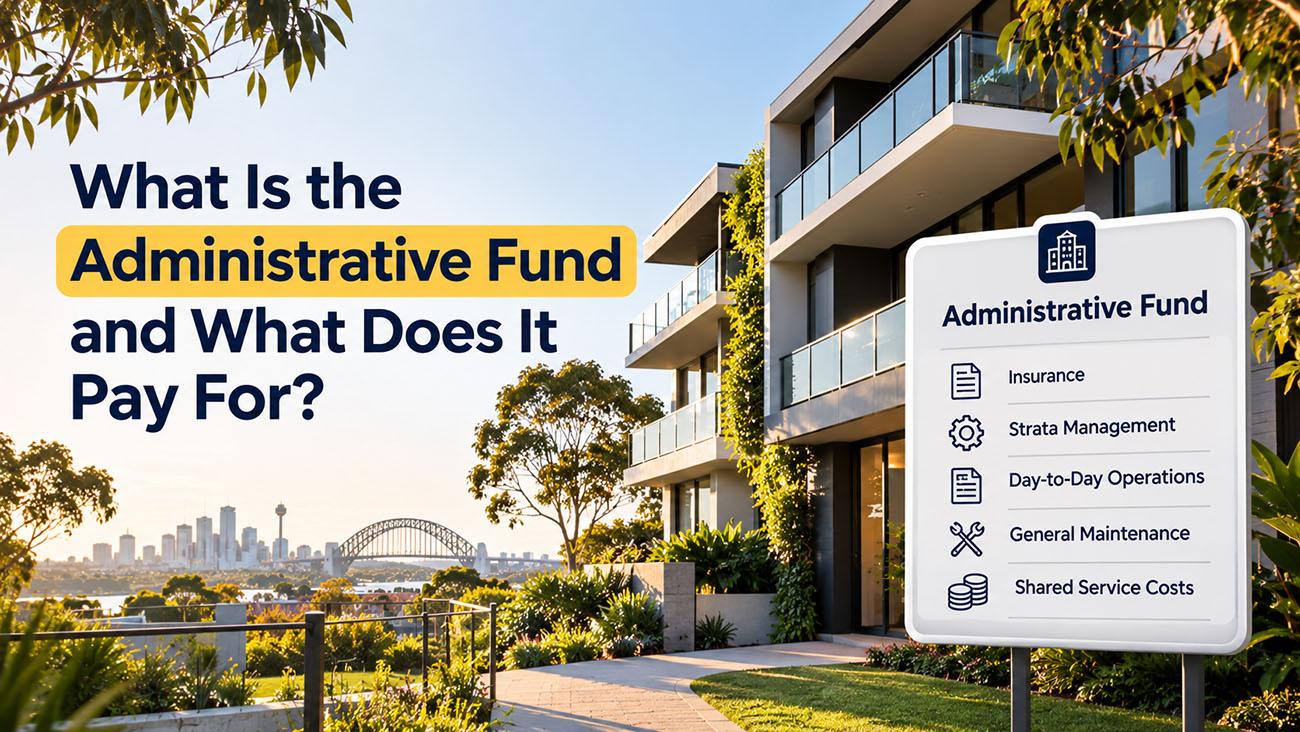
Think of the administrative fund as the scheme’s everyday account. The Queensland Government explains that a body corporate must have an administrative fund if it is registered under the Standard, Accommodation, Commercial or Small Schemes modules. Schemes under the Specified Two-lot Schemes Module do not need formal administrative budgets, though they can agree on certain expenses to help with planning.
Money in the fund can be spent on anything not required to come from the sinking fund. Government guidance lists regular maintenance of common property, insurance charges and administrative expenses such as secretarial fees and postage. The annual budget must also account for other costs that recur each year or more often, such as body corporate management fees and electricity.
In practice, administrative fund spending commonly includes:
- gardening and lawn care on common property;
- cleaning common areas;
- insurance premiums;
- management fees;
- common area electricity and other recurring operating costs;
- administration and record keeping; and
- routine repairs.
In short, the administrative fund pays for regular and recurring expenses rather than major long-term replacement projects.
What Is the Sinking Fund and Why Is It Important?
The sinking fund is the scheme’s long-term savings account for larger, less frequent costs. Queensland bodies corporate under the standard-type modules must keep one alongside the administrative fund, and money cannot be transferred from one fund to the other. That separation is deliberate: it stops everyday spending from eating into money set aside for big jobs.
Typical sinking fund expenses include:
- repainting common property;
- resurfacing shared driveways;
- replacing major shared equipment, such as pool or lift equipment;
- significant repairs to shared facilities; and
- other major common property maintenance and renewal.
It is worth being clear about what the sinking fund is not. It is not simply an emergency savings account. It is part of the scheme’s planned financial management, built up through regular contributions so that, ideally, money is available when large works fall due. A scheme with a thin sinking fund and a lot of ageing common property may face higher costs or extra contributions later, which is why the balance matters when you are buying.
Does Body Corporate Cover Building Insurance?
Often, but not always, and not in the same way for every property. This is the area where owners are most commonly caught out, so it is worth reading carefully.
The Queensland Government says a body corporate must have compulsory insurance for:
- the common property;
- body corporate assets (such as gym equipment or pool furniture);
- public risk; and
- in most cases, every building that contains a lot.
Public risk insurance
Public risk insurance covers amounts the body corporate could be liable to pay for death, illness, injury and damage to property. Under the BCCM Act the policy must be for at least $10 million for a single event, and at least $10 million for the period the policy covers. It applies to the common property and to body corporate assets where it is practical to insure them.
Common property and body corporate assets
The body corporate must insure common property and body corporate assets for their full replacement value. The policy must cover damage, the extra costs of reinstating or replacing buildings (such as professional fees or removing debris) and returning the property to new condition.
Building insurance depends on your survey plan
Here is the catch. Whether the body corporate insures the buildings themselves, and how far that cover extends, depends on the applicable legislation and the scheme’s registered survey plan. The words “in most cases” in the government’s guidance matter. Do not assume the body corporate’s policy automatically covers your townhouse building or everything inside it. In a standard format plan scheme, which is common for townhouse complexes, an owner may be responsible for insuring their own lot unless the body corporate has arranged a shared insurance scheme. Your insurance certificate and policy details will tell you what applies.
What you still need to arrange yourself
Owners are generally responsible for insuring their own contents. Depending on your scheme, you may also need other cover for items or risks the body corporate policy does not include. When you buy, you should receive a copy of the insurance certificate with the body corporate certificate. Read it, and check with your insurer or broker whether your own cover fits with the body corporate’s. In short:
- Building insurance: covers the structure, where the body corporate must insure it for your scheme type.
- Public risk insurance: covers the body corporate’s liability for injury or property damage involving common property.
- Common property and asset insurance: covers shared areas and body corporate-owned items.
- Contents insurance: covers your belongings, and is generally your responsibility.
Who Is Responsible for Maintaining Common Areas and Shared Facilities?
The body corporate generally maintains common property, and the Queensland Government notes it must keep it in a good and structurally sound condition. Practical examples include:
- shared driveways and roads on common property;
- common gardens, lawns and landscaped areas;
- swimming pools and BBQ areas;
- shared gyms and tennis courts;
- common pathways and shared lighting; and
- other body corporate assets.
Government guidance on both standard format plans and building format plans lists roads, gardens, lawns and facilities such as pools and barbecues on common property as body corporate maintenance items.
Exclusive-use areas
Some lots have the benefit of an exclusive-use area, such as a courtyard or car space on common property. Under both plan types, the owner is generally responsible for maintaining an exclusive-use area they benefit from, unless the exclusive-use by-law says otherwise. If you are buying, check the registered by-laws for this.
What Does Body Corporate Usually Not Cover?
Many owners assume the body corporate looks after everything outside their front door and they look after everything inside. In Queensland the real boundary is more complicated, and the answer depends on your scheme’s survey plan.
The Queensland Government explains that the two common types of plan are building format plans and standard format plans, and that you need to know your plan type and your regulation module to work out who maintains what. A copy of your registered survey plan and community management statement can be obtained from Titles Queensland.
Standard format plans (common for townhouses)
In a townhouse complex registered under a standard format plan, each lot typically has its own building and yard, and lot owners carry more responsibility. According to the government, the lot owner is generally responsible for:
- the inside of the building, including fixtures and fittings;
- the outside of the building within the lot boundary, including exterior walls, doors, windows and roof;
- the building foundations;
- lawns, gardens and driveways inside the lot boundary; and
- utility infrastructure (equipment, pipes and wiring) inside the lot that only services that lot.
So in this kind of scheme, a roof repair on your townhouse may well be your responsibility, not the body corporate’s.
Building format plans (common for units)
Under a building format plan, which usually applies to multi-storey unit complexes but can apply to townhouses and other developments too, the body corporate takes on more. For schemes under the BCCM Act, it is usually responsible for the outside of the building, the foundations and roof, essential structural elements, and utility infrastructure on common property or servicing more than one lot. The lot owner is generally responsible for the inside of the lot, including fixtures and fittings, and for utility infrastructure that only services their lot.
Other things that usually stay with the owner
- Contents and belongings: furniture, appliances and personal items.
- Cleaning inside your lot.
- Damage caused by you or by failing to maintain your lot. An owner may be liable if poor maintenance causes damage to another lot or to common property.
- Improvements you install for your own benefit, including on common property in most cases.
- Certain private equipment, such as hot water systems, air-conditioning units, washing machines or solar panels that only service your lot.
The body corporate generally cannot pay for, or levy owners for, maintenance that is a lot owner’s responsibility, unless it has an agreement with that owner and charges them for the work.
Because responsibility depends on the plan type, the location of the item, the legislation and any exclusive-use by-laws, avoid assuming that “inside is yours, outside is theirs”. Check your own scheme’s documents or ask the body corporate manager or secretary.
What Happens When Major Repairs or Unexpected Expenses Arise?
Well-run schemes plan for major work in advance, and the sinking fund exists for that purpose. But sometimes costs are higher than expected or were not budgeted for at all.
The Queensland Government explains that when a body corporate faces unexpected costs during the financial year, either because they were not in the budget or not enough money was set aside, it can collect a special contribution, often called a special levy. For example, if repainting the common property costs more than the sinking fund budget allowed, the body corporate can decide to collect a special contribution to cover the difference. It must pass an ordinary resolution at a general meeting to do so.
A few points worth knowing:
- Special levies are not automatic, and not every complex raises them.
- Examples of events that could lead to one include a roof repair, replacing pool equipment or major driveway work, but the actual cost and process vary from case to case.
- The committee may also fix an interim contribution to cover a gap between financial years, which is later offset against the budget decided at the next general meeting.
Reading the financial statements and meeting minutes before you buy, and regularly after, is the best way to spot looming major expenses.
Why Can Body Corporate Fees Increase?
Levies are set each year based on the budgets owners approve, so they can go up or down. Common reasons they rise include:
- higher insurance premiums;
- rising maintenance and contractor costs;
- ageing buildings and common property needing more repairs;
- new or upgraded shared facilities;
- higher electricity and service costs;
- previous budgets that did not allow enough for future needs; and
- major repairs and replacement projects.
An increase is not automatically unreasonable. The useful question is why. The annual budgets, financial statements and meeting minutes should show the reasoning. Per the Queensland Government, the annual levies are decided at each annual general meeting, where owners approve the administrative and sinking fund budgets, so owners have a say in the process.
How levies are calculated
Your share is generally based on the contribution schedule lot entitlements listed in the scheme’s community management statement. If your lot’s entitlement is a larger proportion of the total, you pay a larger proportion of the budget. There are exceptions. For example, insurance contributions in a building format plan scheme are based on the interest schedule lot entitlements instead.
How Can You Find Out Where Your Body Corporate Fees Are Going?
You do not need to guess. These are the places to look:
- Your levy notice: shows what you owe, the due date and any discount or penalty that applies.
- The administrative fund budget: shows the expected regular expenses for the year.
- The sinking fund budget and forecast: shows planned major works and how much is being set aside.
- Financial statements: show what was actually spent.
- Committee and general meeting minutes: record decisions, quotes, disputes and planned works.
- Insurance information: including the policy details and any valuation.
- The body corporate manager or secretary: ask for clarification on items you do not understand.
You can also request body corporate records. The Queensland Government says the owner or buyer of a lot can ask to inspect or get copies of records by making a written request and paying the fee, and the body corporate must give access within seven days of receiving the request and fee. It helps to be specific about what you want to see.
Are body corporate fees tax deductible?
If you own an investment property, the answer depends on your circumstances and the type of expense. According to the Australian Taxation Office, you may be able to claim a deduction for body corporate fees and charges, but not all of them are deductible in full in the year you incur them. In general terms, the ATO treats regular payments to administrative funds or general-purpose sinking funds as deductible when incurred, while a special levy for a particular capital improvement is not deductible in the same way. Special levies may instead lead to capital works deductions in some cases. The ATO page was last updated in May 2026, and the rules can change, so check the current guidance and speak to a registered tax agent or accountant about your own situation. If you live in the property yourself, these deductions generally do not apply.

What Should You Check Before Buying a Property With Body Corporate Fees?
Body corporate costs are part of your ongoing cost of ownership, so they deserve as much attention as the purchase price. Under Queensland’s seller disclosure scheme, which has applied since 1 August 2025, sellers of lots in a community titles scheme must provide a community management statement and a body corporate certificate before the buyer signs the contract. Beyond that, a thorough buyer should check:
- the current quarterly or annual levy amounts;
- the administrative fund contributions;
- the sinking fund balance and forecast;
- any approved or proposed special levies;
- the building, public risk and common property insurance details;
- planned maintenance and major repairs;
- the condition of shared facilities;
- financial statements and budgets;
- recent committee and general meeting minutes;
- the registered survey plan, to confirm whether it is a standard or building format plan;
- the community management statement, including by-laws and exclusive-use areas; and
- the applicable legislation and regulation module.
Ask your solicitor or conveyancer to review these documents before you sign. They can explain what the numbers and clauses mean for you and flag potential problems.
Final Thoughts: Understand What Your Body Corporate Fees Pay For
Body corporate fees contribute to the management, insurance, maintenance and operation of shared property and assets. The administrative fund covers regular running costs, the sinking fund prepares for larger future works, and a special levy may apply if costs exceed what was planned. What the body corporate covers and what remains your responsibility depends on your scheme’s registered survey plan, applicable legislation, community management statement and by-laws.
The most useful thing you can do is read your own scheme’s documents rather than assuming all body corporate arrangements are the same. If something does not add up, ask for the budget, the financial statements or the records, and get advice from a qualified professional where it affects your money or your contract.