
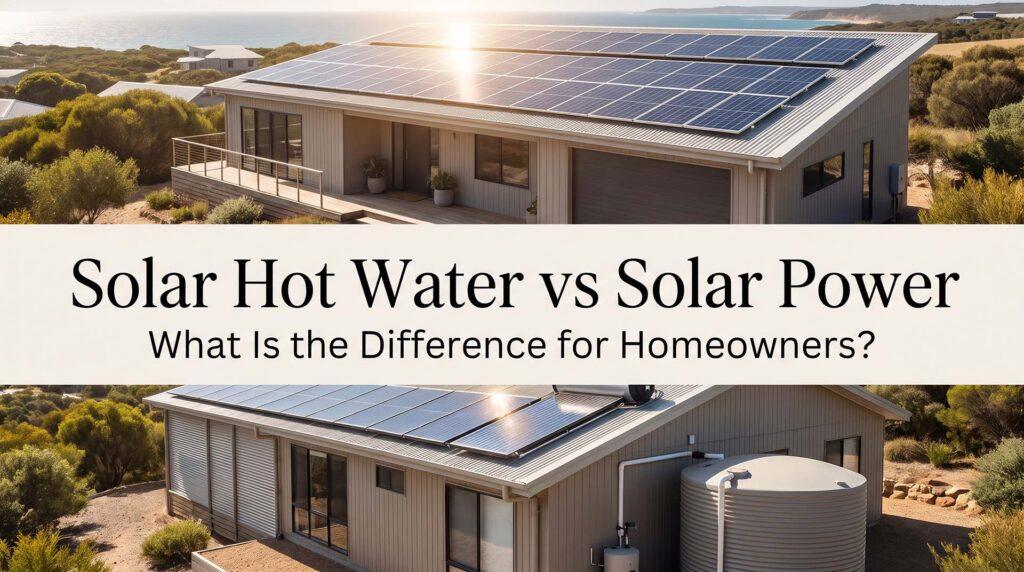
Look across the rooftops of almost any Gold Coast suburb and you’ll see a mix of equipment: flat panels, rows of glass tubes, a cylindrical tank here and there, and sometimes a box on the side of the house. Many homeowners and buyers aren’t sure what each piece does. When it comes to solar hot water vs solar power, the difference is simple. Solar hot water uses the sun’s heat to warm water. Solar power, usually called solar PV (photovoltaic), turns sunlight into electricity.
That difference matters in practice. A listing that says “solar” could mean either system, or both, or neither in working order. Knowing which is which helps you judge what you’re buying, what it can do for the household, and what looking after it involves. This guide explains how each system works, how they affect energy use, how to recognise them, and what to check before you buy.
What Is a Solar Hot Water System?
A solar hot water system heats household water using the sun. The Clean Energy Regulator explains that collectors are usually placed on the roof but are different from solar panels because they generate heat instead of electricity. A system typically includes a storage tank, a heat exchanger, a controller and a backup heater.
The basic process is:
- Collectors on the roof absorb heat from the sun. The two main types are flat plate collectors and evacuated tube collectors, which use rows of glass tubes.
- Water, or in some systems a heat-transfer fluid, is warmed as it passes through the collectors.
- The heated water flows into an insulated storage tank.
- Hot water from the tank supplies the bathroom, kitchen and laundry.
- When there isn’t enough sun, or demand is high, a booster takes over.
The booster is an important part of the system. The Australian Government’s YourHome guide says most solar water heaters come with a gas or electric booster to provide hot water on cloudy days or when demand exceeds supply. It adds that, depending on the climate, a solar hot water system can provide up to 90% of a home’s hot water. That is a ceiling, not a guarantee. The solar share varies with the season, the weather, the system design and how much hot water the household uses.
Roof-Mounted or Close-Coupled Systems
In a close-coupled system the collectors and tank sit together on the roof, with the tank mounted directly above the collectors. These work on a natural principle called thermosiphon. Water warmed in the collectors becomes lighter and rises into the tank, while cooler water sinks to replace it, so water circulates without a pump. YourHome notes that the roof must be strong enough to carry the weight of a tank full of water.
Split Solar Hot Water Systems
In a split system the collectors stay on the roof, but the tank is at ground level or another convenient spot. A small electric pump moves water or fluid between the collectors and the tank. These systems have less visual impact on the roof, but YourHome says they are usually more expensive to buy and need more maintenance than passive systems.
What Is a Solar PV System?
Solar PV panels make electricity. The Australian Government’s energy website explains that when sunlight hits a panel, the light is converted into electricity through the photovoltaic effect. Panels can still generate some electricity on cloudy days, though most is produced when direct sunlight hits them on clear days.
The process in a typical home system is:
- Sunlight reaches the photovoltaic cells in the panels.
- The cells produce direct current (DC) electricity.
- An inverter converts that into alternating current (AC), the type your home uses.
- The household uses what it needs as it is generated.
- In a grid-connected system, any surplus may be exported to the grid. YourHome notes that a payment or credit, known as a feed-in tariff, is usually made for this, though the rate depends on your electricity arrangement.
What Does a Solar Inverter Do?
The inverter converts the DC electricity from the panels into the AC power used by household appliances. YourHome describes it as a crucial part of both grid-connected and stand-alone systems, because it connects the panels, and any battery, to the house and the grid. Inverters are usually mounted on a wall or shelf, need decent ventilation and should be kept out of direct sunlight. Only a suitably qualified person can do the AC wiring for an inverter.
What Is the Role of a Solar Battery?
A solar battery stores electricity from a PV system for later use. The Australian Government says a battery can store energy for use when panels are not generating enough electricity, such as at night or when it is cloudy, or at times when electricity costs more.
A battery is not the same as a hot water tank. A hot water tank stores heated water, while a battery stores electrical energy. A solar hot water system doesn’t produce electricity, so there’s nothing for a battery to store from it.
Solar Hot Water vs Solar Power: The Main Differences
The table below shows the typical features of each system. Individual installations vary, and not every home will have the same components.
| Feature | Solar Hot Water | Solar PV |
|---|---|---|
| Main purpose | Heats household water | Generates electricity |
| Main components | Solar collectors, storage tank, booster (plus controller and pump in some systems) | PV panels, inverter |
| Energy produced | Heat | Electricity |
| Main household use | Hot water for showers, kitchen and laundry | Appliances, lighting and other electrical loads |
| Storage | Insulated hot water tank | Optional battery |
| Backup | Electric or gas booster | Grid electricity or battery, depending on the system |
| Maintenance | Collectors, plumbing, tank and booster; pump and controller in split systems | Panels, inverter, wiring and optional battery |
How Can These Systems Affect Household Energy Bills?
Solar Hot Water and Water Heating Costs
Water heating is a big part of household energy use. YourHome says 23% of the energy used in an average Australian home goes to heating water, and in some homes it’s much more. Because a solar hot water system uses the sun for part of that job, it can reduce the energy needed to heat water.
How much it reduces it depends on the household’s hot water use, the system design, the local climate, and how the booster is set up. YourHome warns that a poorly designed or operated booster can reduce the solar contribution. If the booster still runs on gas or electricity, it will still add to bills at times.
Solar PV and Electricity Bills
Solar PV can power appliances while the sun is shining, which reduces the electricity you buy from the grid. How much you save depends on how much of the generated electricity the household uses directly, as opposed to exporting it. Feed-in tariffs and retail electricity rates vary between retailers and change over time, so savings can’t be predicted in advance. If you’re assessing a property, recent electricity bills give a better picture than general claims.
Can Solar PV Also Help Heat Water?
Yes, though this is different from a dedicated solar hot water system. A conventional electric storage hot water system can use electricity from rooftop solar PV. YourHome describes two common approaches:
- A timer, which switches the water heater’s element on during the day, when the PV system is most likely to be generating. The heater will still draw grid electricity if there isn’t enough solar power at that time.
- A diverter, which sends surplus solar electricity to the water heater first, rather than exporting it to the grid.
The Clean Energy Regulator also notes that an air source heat pump, which runs on electricity, can use excess solar power in the same way. In each of these cases, the water is heated with electricity, not directly by the sun’s heat.
How Can You Tell Which Solar System a Property Has?
When you’re inspecting a home, a few visual clues can point you in the right direction.
Signs of solar hot water:
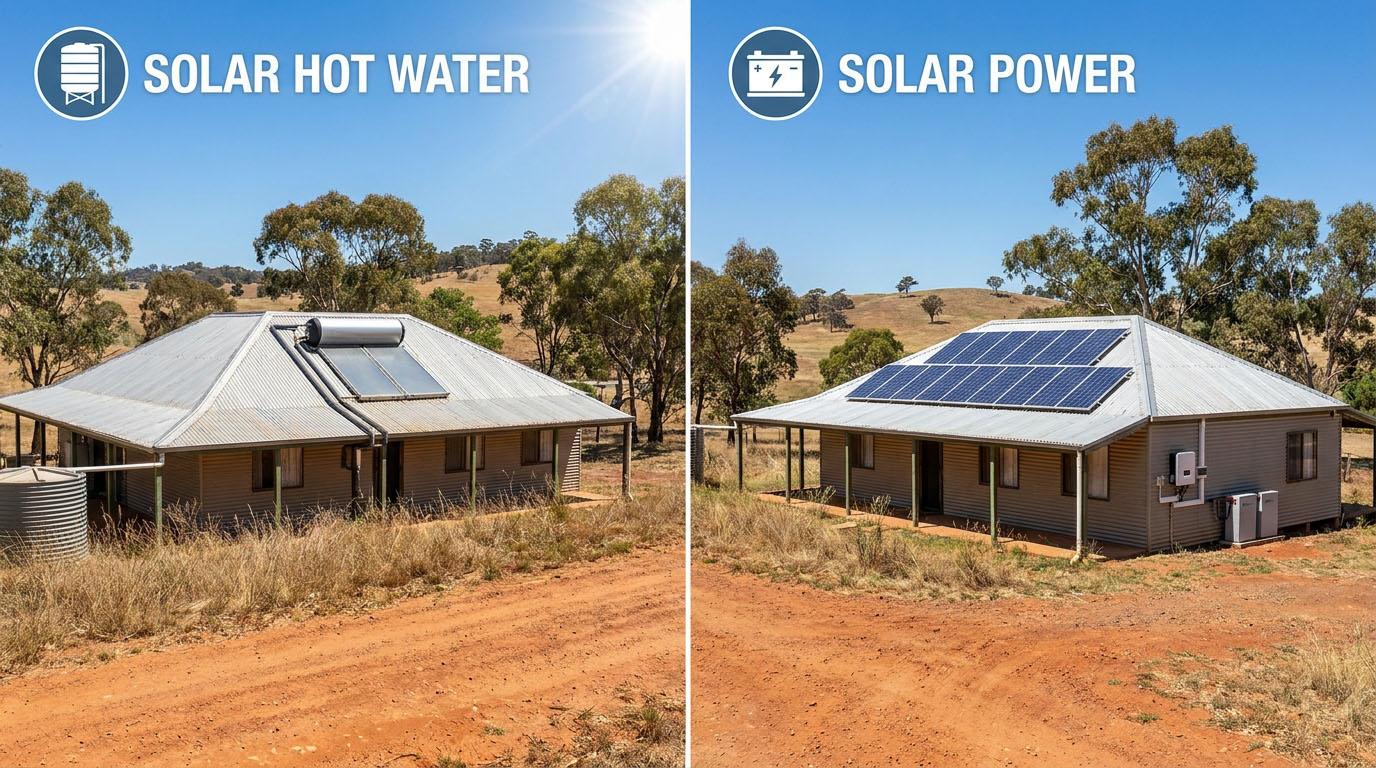
- A large cylindrical tank on the roof, sitting just above one or more collectors.
- Flat collector panels or rows of glass evacuated tubes on the roof.
- In a split system, collectors on the roof and a separate tank at ground level, with pipework connecting them.
Signs of solar PV:
- Multiple flat rectangular panels arranged across the roof. According to energy.gov.au, panels used for household systems are typically around 1 metre wide by 1.7 metres long.
- An inverter on an external wall, in a garage or in another suitable spot.
- A separate wall-mounted or floor-standing unit that may be a battery.
Appearances can be misleading. Flat solar hot water collectors and PV panels can look alike from the street, and a tank at ground level could belong to a conventional electric, gas or heat pump system. Ask the seller or agent, ask for the installation documents, and have a qualified professional confirm what is installed if you’re unsure.
What Maintenance Do Solar Hot Water and Solar PV Systems Need?
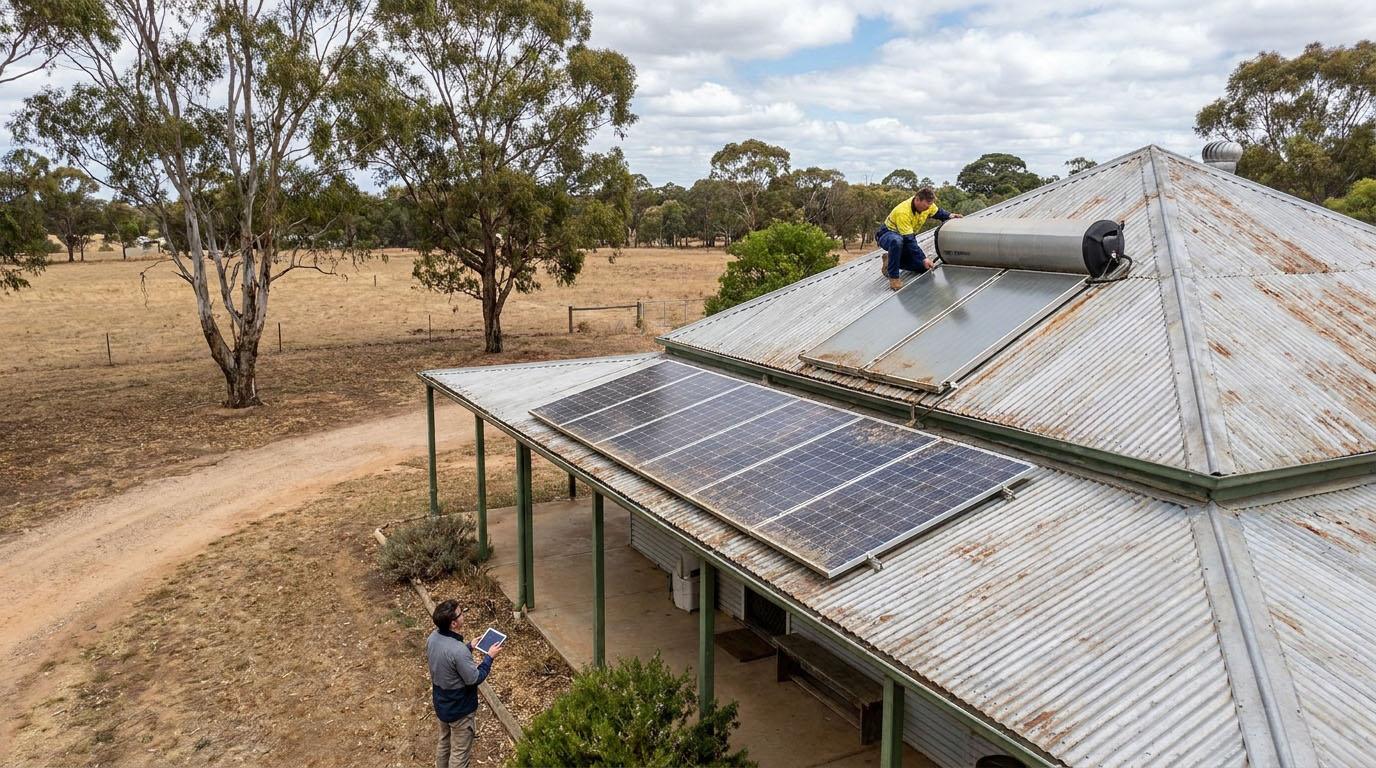
Neither system is maintenance-free, and the right approach depends on the design, the manufacturer and the age of the equipment. Always follow the manufacturer’s instructions and use qualified technicians. Please don’t climb onto the roof or work on electrical equipment yourself.
Solar Hot Water Maintenance
Things that may need attention include:
- checking collectors and pipework for leaks or visible damage
- keeping collectors reasonably clean, as YourHome recommends removing dust, and flushing sludge from the collectors where the manufacturer advises
- the condition of the storage tank and its insulation
- the booster and its controls
- pumps, sensors and controllers in split systems
YourHome notes that some tanks have a sacrificial anode that needs replacing every few years, and that the fluid in closed-circuit systems needs checking or replacing at intervals. The right schedule depends on the product, so refer to the manufacturer’s instructions rather than relying on a general rule.
One point for split systems is worth knowing. YourHome warns that if the pump or sensors fail, it may not be obvious, because the booster keeps heating the water. A hot water bill that rises without explanation can be a sign of a fault.
Solar PV Maintenance
Solar PV also needs some attention:
- Monitoring performance. Many systems have an app or display. A sudden drop in output is worth investigating.
- Keeping panels clear. The energy.gov.au solar panels guide lists dirt, debris and shading among the factors that reduce output.
- Checking for visible damage from the ground, such as cracked panels or loose cabling.
- Inverter warnings. Error lights or messages should be checked by a qualified person.
- Professional inspection. YourHome says Australian Standard AS/NZS 5033 recommends that owners have system components, including DC isolators, inspected regularly and annually.
- Batteries. If a battery is installed, follow the manufacturer’s requirements.
Can a Property Have Both Solar Hot Water and Solar PV?
Yes. Many homes do. YourHome illustrates this with a house in Brisbane that has a solar storage hot water system and a solar photovoltaic array.
In a home like that, the solar hot water system heats the water for showers and general use, the PV system generates electricity for appliances and lighting, and a battery, if there is one, stores some of that electricity for later.
Having both doesn’t mean the household has no energy costs. The booster, grid electricity, tariffs, household consumption and the condition of the equipment all still affect what you pay.
What Should Buyers Check Before Purchasing a Home with Solar?
A listing that says “solar” doesn’t say much on its own. A practical checklist helps:
- Does the property have solar hot water, solar PV or both?
- Is each system working?
- How old is the equipment?
- Are the installation documents available?
- Is there an inverter and, if so, is it showing any faults? Is there a battery?
- Does the hot water system use an electric or gas booster?
- Are there any known faults or maintenance issues?
- Are warranties and service records available?
- Is the system owned outright, or is it part of a lease or other agreement?
- Can the seller provide recent electricity bills or relevant system information?
Having a solar system doesn’t mean a property is worth more or that your bills will be lower, so treat it as one factor among many. A building inspector or licensed electrician or plumber can confirm what you can’t see for yourself, and if you’d like help with inspections and due diligence when buying on the Gold Coast, our property buying service explains how we can assist.
Solar Hot Water vs Solar Power: Which System Does Your Home Need?
The distinction comes down to what each system is built to do. Solar hot water exists to heat household water, while solar PV makes electricity that can power a wide range of equipment, including, with the right setup, an electric water heater. A home may benefit from either one or both, depending on its energy use, roof space, budget and existing equipment.
If you’re buying, don’t rely on the word “solar” in a listing. Find out exactly what is installed, whether it works, and what it will need from you over the years. That will tell you far more than a general description.