

You inspect a house on a Saturday morning. The street is quiet, you can hear birds from the back deck, and the living room feels calm. It is easy to picture yourself settling in. Then you move in and find that the street becomes a shortcut for commuters at 7.30am, a neighbour’s air conditioner runs late into the evening, and flights or trains pass at times you never saw.
Thinking about noise before buying a home is easy to skip, because it is hard to see in a listing and a single inspection rarely shows the full picture. It is also one of the things that can quietly decide whether a property suits how you live. This guide explains what to look and listen for, what you can realistically check, and where to find reliable information, with a focus on Queensland and the Gold Coast.
Why Noise Matters When Buying a Home
Noise is not just an annoyance. The sound around a property can shape how a home works for you day to day:
- Sleep and rest: bedrooms facing a busy road or a neighbour’s air conditioner can feel very different at 2am than at 2pm.
- Working from home: calls and concentration are harder with regular construction, traffic or barking nearby.
- Family routines: shift workers, babies and young children all have different sensitivities to noise at different times.
- Privacy: sound travels both ways. Thin walls or a close neighbouring window affect your privacy as well as your peace.
- Outdoor living: a patio that is lovely on paper may be unpleasant if it faces a road, a venue or a pool pump.
It also works the other way. Some people enjoy a lively area and barely notice traffic, while others find the same street stressful. There is no single “right” level of noise. What matters is whether the sound environment suits you and your household.
Common Noise Sources Buyers Should Look Out For
No source is automatically a deal-breaker. The effect depends on distance, how often it happens, the time of day, which way the home faces and how the building is designed.
Busy Streets, Highways and Major Roads
Road traffic is the most common source of noise around homes. Pay attention to more than the volume of cars. Trucks, buses, motorbikes, intersections where vehicles brake and accelerate, and hills where engines work harder can all change how a street sounds.
It also helps to know who manages the road. The Department of Transport and Main Roads (TMR) assesses road traffic noise for state-controlled roads, which generally means arterial roads, highways and motorways. Local roads are managed by local councils under their own policies. TMR explains this in its road traffic noise fact sheet.
Queensland also has designated transport noise corridors along some state-controlled roads, major local roads and railway lines. In mandatory areas, new residential building work must meet noise measures set out in the Queensland Development Code (MP 4.4). Two things are worth remembering. First, these rules apply to new building work, so an older home near a busy road may have no noise treatment at all. Second, a property sitting inside a corridor tells you that the location is noise-affected, which is useful information in itself. You can check an address using the mapping tool described on the Queensland Government’s transport noise corridors page.
Trains and Light Rail
Rail noise comes from the trains themselves and also from things like horns, bells, braking and announcements. Railway lines, including the South East Queensland passenger network, can be part of a transport noise corridor. Light rail brings regular passing trams and station sounds. How much you notice depends on your distance from the line, the direction your home faces and what time of day it is. Property Sphere’s article on living near a light rail station covers the everyday trade-offs in more detail.
Aircraft
Aircraft noise on the Gold Coast is mainly relevant near Gold Coast Airport and under its flight paths. The airport operates under a curfew from 11pm to 6am, with exceptions possible through a quota and dispensation system, so quiet overnight does not mean no flights in every case. It also does not mean the rest of the day is quiet.
Buyers who are near the airport should look at the airport’s noise information, including its flight track map and the Australian Noise Exposure Forecast (ANEF) map in its master plan. Both are available through Gold Coast Airport’s noise information page. Airservices Australia handles aircraft noise complaints and publishes information about the airport’s flight paths and noise abatement procedures.
Neighbours and Neighbouring Properties
Everyday neighbour noise is often what people notice most after moving in, and it is usually the hardest to judge at an inspection. Common examples include barking dogs, air conditioners, pool pumps, outdoor entertaining, power tools and music.
Some of these have rules. In Queensland, the Environmental Protection Act 1994 is the main framework for noise from homes, businesses and industry, and councils generally handle complaints. The Queensland Government’s noise fact sheet sets out the standards. For example, regulated devices such as lawn mowers, leaf blowers and power tools cannot be used before 7am or after 7pm Monday to Saturday, and before 8am or after 7pm on Sundays and public holidays. Air conditioners and pool pumps have limits tied to background noise. Parties and loud music are not covered by those provisions and are a matter for the Queensland Police Service.
Barking dogs have their own test. Under the City of Gold Coast’s process, barking is a nuisance if, in an authorised officer’s opinion, it unreasonably interferes with the peace, comfort and convenience of someone on their property and lasts more than 6 minutes in any 60-minute period between 7am and 10pm, or more than 3 minutes in any 30-minute period between 10pm and 7am. The council also notes that if it cannot establish a nuisance, it cannot take further action, even if the noise is annoying. That is a useful reminder that a complaint process is not the same as a quiet street, so it is better to find out before you buy.
In units and townhouses, noise through shared walls, floors and ceilings can matter as much as noise from outside. Ask for the body corporate by-laws and pay close attention to how sound carries between homes when you inspect.
Schools, Playgrounds and Sporting Facilities
These sources tend to be loud at predictable times: drop-off and pick-up, recess and lunch, weekend sport and evening training. A property next to a school may be very quiet on a Saturday and very different on a Wednesday morning. Sporting fields can also have lights, public address systems and crowds on weekends. If you inspect outside those times, you will miss them completely.
Restaurants, Cafés, Entertainment Venues and Nightlife
Dining and entertainment strips are popular for good reasons, but they often have late-night noise, delivery and rubbish collection early in the morning, and people leaving venues. In Queensland, noise from licensed premises is handled by the Office of Liquor and Gaming Regulation, while the City of Gold Coast deals with certain venues, including indoor and amplified music venues in the Southport Special Entertainment Precinct. If you are looking at a property in or near a nightlife area, visit on a Friday or Saturday night.
Construction Sites and Future Development
Construction noise is usually temporary, but temporary can still mean months or years for large projects. Under Queensland’s noise rules, building work by registered contractors and owner-builders is restricted before 6.30am and after 6.30pm Monday to Saturday, and at any time on Sundays and public holidays. Look around the street for building sites, cleared lots, development signs and cranes, and see the section below on researching future development.
Commercial, Industrial and Other Nearby Activities
Shopping centres, car parks, warehouses, service stations and light industrial areas can bring delivery trucks, refrigeration plant, air conditioning units and early or late operating hours. The City of Gold Coast handles noise from industrial activities, air-conditioning and refrigeration units and similar equipment. A business that is quiet in the afternoon may be noisy at 5am when deliveries arrive.
Why One Property Inspection May Not Tell You the Whole Story
Most inspections happen in the middle of the day, often on a Saturday. That is the time when many noise sources are least active. A property can sound very different at other times:
- Weekday peak hours: morning and afternoon traffic, buses and trains.
- School hours: arrivals, departures and break times.
- Evenings and nights: venues, outdoor entertaining, air conditioners and late-night flights or trains.
- Weekends: sport, gardening, lawn mowing and parties.
- Construction schedules: work often starts early and finishes mid-afternoon.
- Seasons and weather: windows open in summer, school holidays, event seasons, and wind direction carrying sound from a road or airport.
That is why relying on a single visit is risky. Treat the first inspection as a starting point rather than a conclusion.
How to Assess Noise During a Property Inspection
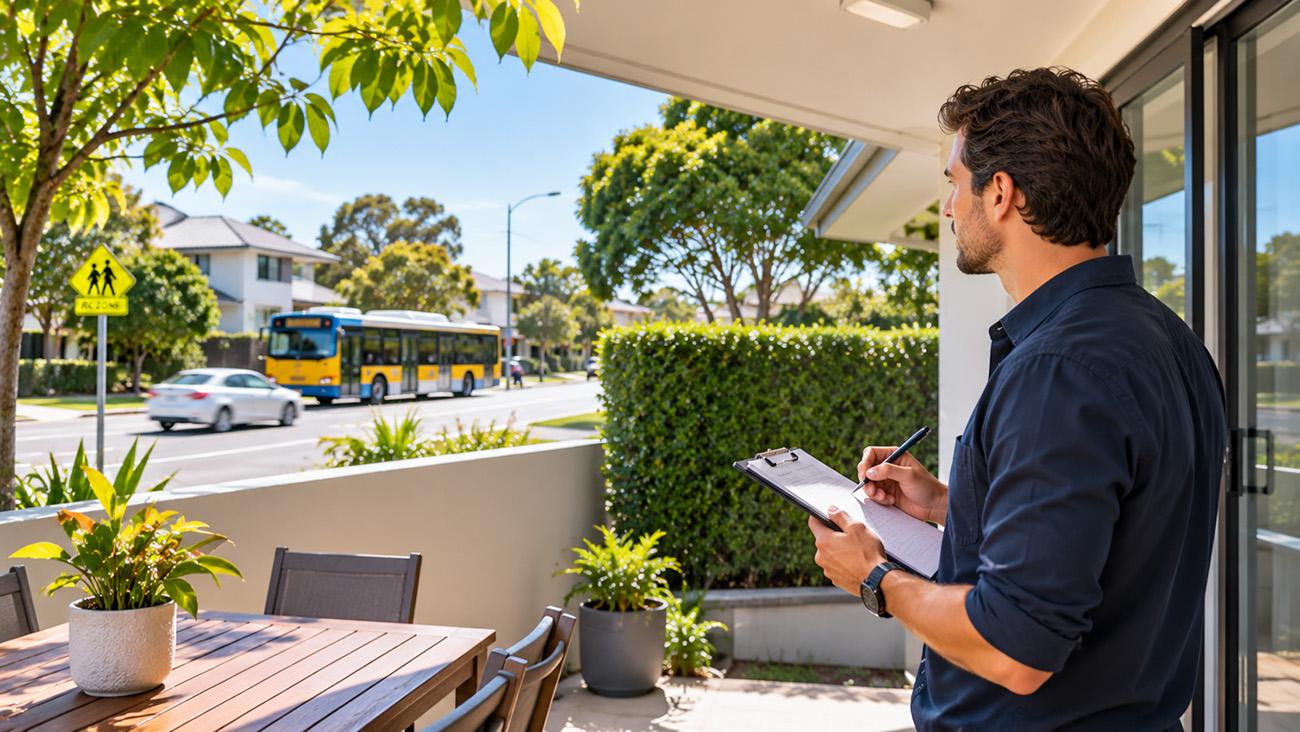
You do not need special equipment. You mostly need to slow down and listen. Useful things to do:
- Stand quietly for a few minutes inside and outside, rather than only talking and walking through.
- Spend time in the bedrooms and main living areas, since these are where you will notice noise most.
- Listen with the windows open and then closed. The difference shows how much the building is actually doing.
- Go to the backyard, balcony, patio or courtyard and check what you can hear from where you would sit.
- Work out where the main sounds are coming from and which way the home faces.
- Look at the windows, doors and seals for noise-related features such as thick or laminated glass or double glazing.
- In units, townhouses and duplexes, check for sounds travelling through walls, floors and ceilings, and ask about the construction.
- Look for clues about neighbouring activities: dog bowls, air conditioning units close to boundaries, pool equipment, a business sign, a school bus stop.
- Come back at a different time. Try a weekday morning, an evening, or a weekend, as well as the original inspection time.
Phone recordings can be useful for comparing what you heard at different times, but a phone microphone is not a calibrated instrument, so treat them as memory aids rather than measurements. If you are working with a buyer’s agent, ask them to help arrange a second inspection at a different time. Suburb profiles can give you a general feel for an area, but they cannot tell you how a particular street sounds.
Do not rely only on what the seller or agent tells you. They may genuinely not notice a noise that bothers you, and you should not assume that a seller or agent will mention every noise issue. Treat noise as something you check for yourself.
Questions Buyers Should Ask Before Purchasing
Ask the agent or seller:
- Is there any regular noise, such as traffic, aircraft, trains, venues or neighbours? When is it worst?
- Are there any nearby building sites or developments they know about?
- Have there been any noise complaints or disputes, to their knowledge?
- Does the home have any noise-reduction features, such as double glazing, extra insulation or acoustic windows? When were they installed, and is there paperwork?
Ask neighbours, if you get the chance:
- What is the street like on weekday mornings, evenings and weekends?
- Is there anything that bothers them, such as late-night noise, dogs or construction?
Ask the council or relevant authorities:
- Is the property in a transport noise corridor or near a major road, railway or airport flight path?
- Are there any approved or proposed developments, roads or infrastructure nearby?
Check the documents: read the contract and any body corporate information carefully. Property Sphere also has an article on understanding real estate contracts. For units and townhouses, ask for the by-laws, which may include rules about noise.
Can a Home’s Design Help Reduce Noise?
Yes, to a degree. The government’s YourHome guide says that sealing gaps around windows and elsewhere in a building is probably the most effective first step. Beyond that, the glass matters:
- Sealed double glazing helps with medium to high frequency sounds such as voices.
- For low frequency noise such as traffic and aircraft, thicker glass is better, ideally double glazing with a wide gap.
- Thick laminated glass reduces noise transmission well, though it does little for heat.
- Adding secondary glazing to an existing window can help, but it usually does not perform as well as a purpose-made insulated glass unit.
You can read more on YourHome’s glazing page, and the site also has a guide on noise control.
Layout matters too. Bedrooms positioned away from the noisiest side of the property, solid construction, good door and window seals and sensible placement of outdoor areas all help. In multi-level homes and attached dwellings, consider what is above, below and next door to the rooms you will use most.
Be realistic about the limits. Ordinary fencing and landscaping will not eliminate significant noise. Even engineered road noise barriers have limits: TMR says effective barriers typically reduce noise by 5 to 12 decibels, and its Coomera Connector information notes that barriers cannot reduce intermittent noise such as engine braking, motorbikes, modified vehicles or sirens. Plants and screens might improve privacy and softness, but they should not be your main plan for a seriously noisy site.
What About Future Noise and Development?
The sound environment today is not necessarily the one you will have in five years. When buying, look beyond what is there now.
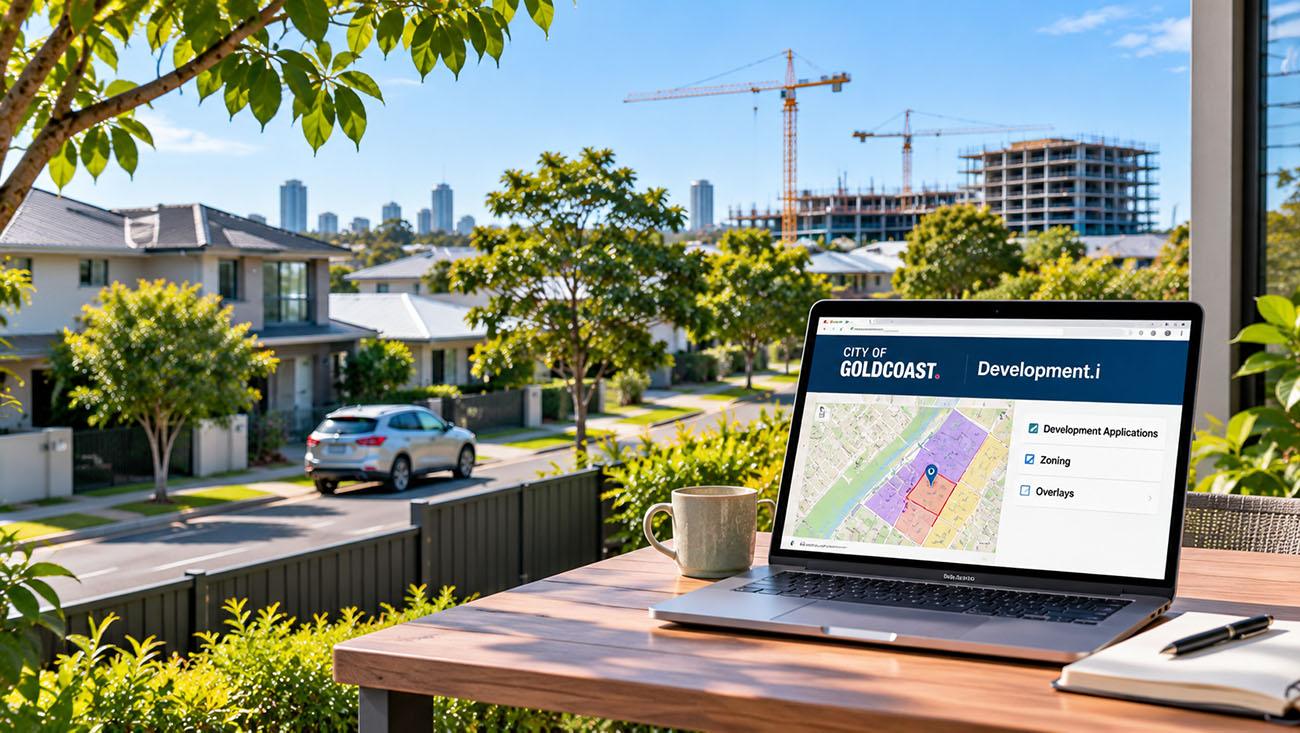
On the Gold Coast, the council’s Development.i tool lets the public search for development applications near an address, check the status of applications and view documents. The council’s PD Online page explains how to find property information, and zoning and overlays can be found through the City Plan interactive mapping. These show what has been applied for or approved nearby, which helps you assess possible construction, commercial uses or changes in density.
For major roads, check what TMR has planned. For example, TMR’s pages for the Coomera Connector Stage 1 road traffic noise explain how noise is assessed for a new road, including noise barriers, in-house treatments such as double glazing where barriers are not feasible, and road surfaces. If a planned road, rail project or major development is near the home you are considering, the planning documents are worth reading rather than assuming it will not affect you.
Investigate possibilities; do not assume them. A vacant block next door may stay vacant or become a multi-storey development. The council and the relevant transport authority are the places to find out.
Does Noise Affect Property Value or Resale Potential?
It can influence how appealing a property is to some buyers, but there is no simple rule. Noise may affect buyer preferences, how desirable a property feels, or how large the pool of interested buyers is, depending on the location and the type of noise. Some buyers will avoid a busy road, while others will accept it for convenience, price or transport access. Tenants have preferences too, and the same applies to investors thinking about rental appeal.
There is no reliable percentage by which noise reduces value, and it varies widely with the property, the market and the buyer. A useful way to think about it is to ask whether the noise is something you could live with, and whether the next buyer is likely to feel the same way. Also consider whether a noise-reduction feature, such as quality glazing, is documented and likely to appeal.
A Noise Checklist Before Making an Offer
- Visit at least twice, at different times of day and on a weekday and a weekend.
- Listen indoors and outdoors, with windows open and closed.
- Note where the main noise sources are and which rooms and outdoor areas face them.
- Check whether the property is in a transport noise corridor, near a state-controlled road, railway or the airport flight paths.
- Look at any noise-reduction features and ask for documentation.
- Search the council’s development tools for approved and proposed projects nearby.
- Check the planned roads and infrastructure for the area with the relevant authority.
- Talk to neighbours if you can, and ask the agent and seller direct questions.
- For units and townhouses, ask for the by-laws and test sound between homes.
- Decide honestly whether the noise environment suits your household, now and in a few years.
Final Thoughts
A home can look right on paper and feel right at an inspection, but you will live in it every hour of the day. Spending a little extra time understanding the sound environment can save you from a purchase that never quite feels comfortable. Visit at different times, look into the neighbourhood and its future, and ask yourself whether the noise you find genuinely suits your lifestyle. A property that suits one household may not suit another, and that is a good reason to check before you commit.
This article is general information only and is not legal, planning or acoustic advice. Rules and council information change, so check current requirements with the relevant council or authority, and consider professional advice for a specific property.