

An outdoor spa can make a home feel like a private retreat. It suits people who enjoy entertaining, unwinding at the end of the day, or making better use of their backyard, which is part of why buying a property with an outdoor spa appeals to so many Gold Coast buyers.
But a spa is more than a feature to admire during an inspection. Owning one means regular cleaning and water treatment, heating and electricity costs, equipment that will eventually need servicing or replacing, and safety and compliance responsibilities under Queensland law. A spa that switches on and heats up on inspection day is not necessarily inexpensive or trouble-free to own.
This guide explains what to look at before you buy, including maintenance, water quality, running costs, Queensland safety requirements, equipment condition and the installation itself, and finishes with a checklist you can take to your next inspection.
Is an Outdoor Spa a Good Feature to Have in a Property?
That depends on how you would use it and how much upkeep you are comfortable with. The potential benefits include:
- Relaxation and personal enjoyment at home
- An extra drawcard for outdoor entertaining
- Making better use of an outdoor living area
- Convenience compared with visiting a public spa or wellness facility
The trade-offs are just as real:
- Regular cleaning and water treatment
- Electricity and heating expenses
- Equipment servicing and repairs
- Safety and compliance responsibilities
It is also worth being cautious about assuming a spa will lift a property’s value. Whether a spa adds to the price a buyer is willing to pay depends on the property, the spa’s condition and the buyer, so it is better to treat it as a lifestyle feature that you assess on its own merits than as a guaranteed financial gain.
Some Gold Coast properties already include outdoor spas as part of their entertaining areas. For example, one Property Sphere listing features a fully operational outdoor spa within a private covered and enclosed entertaining space, with bamboo screening and artificial turf. While this can be an attractive lifestyle feature, buyers should still consider the spa’s maintenance history, operating costs and safety requirements before making a decision.
Understanding Outdoor Spa Maintenance Requirements
Keeping a spa clean, hygienic and in working order involves regular tasks, including:
- Cleaning the spa shell and the surrounding surfaces
- Cleaning filters and pump baskets
- Checking pumps, jets and circulation systems
- Removing leaves, dirt and other debris
- Inspecting the cover and checking for leaks
- Following the manufacturer’s servicing schedule
How much work this involves varies with the spa model, how often it is used, the water treatment system and the manufacturer’s instructions. In a leafy Gold Coast backyard with frequent rain and storms, debris management and cover care may be a bigger part of the routine than in a more sheltered spot. Ask the owner what a typical week or month of upkeep looks like, and who currently does it.
Why Spa Water Quality Matters
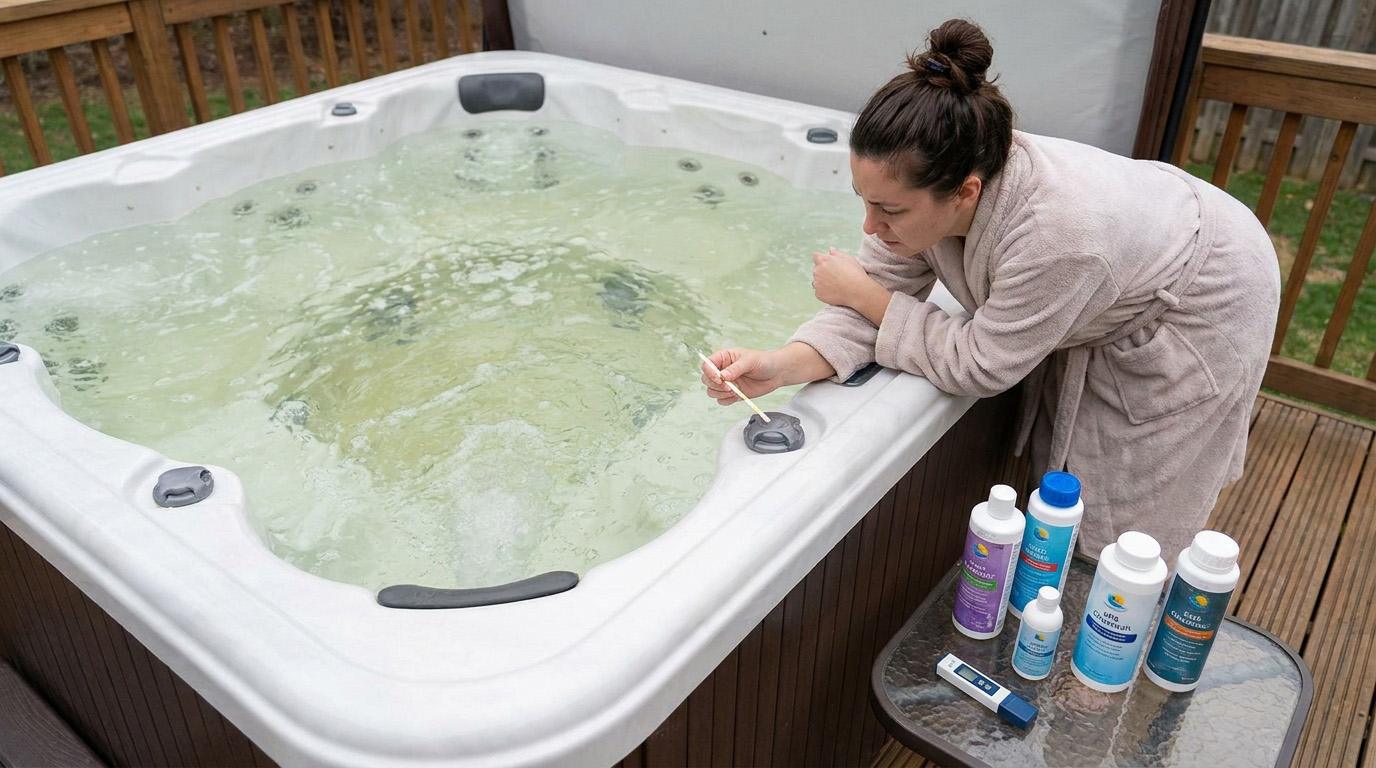
Water quality deserves particular attention with spas. SA Health explains that warm water provides ideal conditions for the growth of microorganisms, so a spa that is not properly disinfected and filtered can become a source of infection. The same guidance notes that contaminated water can cause skin, ear and eye infections, stomach upsets and, in serious cases, respiratory illness, with babies, older people and people with weakened immune systems being more susceptible.
Good water management generally involves:
- Maintaining suitable sanitiser levels and chemical balance
- Monitoring pH and alkalinity
- Testing the water regularly
- Running effective filtration and circulation
- Cleaning the filter and pump components
- Draining and refilling the water when required
The SA Health factsheet is South Australian guidance, but its core message is relevant anywhere: keep the water clean and disinfected, and keep the filtration and circulation systems working. Exact chemical levels, testing frequency and water-change intervals differ between spas and sanitising systems, so follow the manufacturer’s instructions and ask a qualified spa technician rather than relying on a single rule of thumb. As a buyer, a spa that looks cloudy or neglected, or an owner who cannot describe how the water is managed, is worth noting.
How Much Does It Cost to Heat and Run an Outdoor Spa?
There is no reliable single figure for what a spa costs to run. The Government of South Australia notes that for outdoor spa pools, heating is the main running cost and that costs depend on how often the spa is used, how the water is heated, whether it stays filled between uses and how much heat it loses to the environment. Because tariffs, climate and equipment differ, any cost estimate from another state or a brochure should be treated as a rough guide only, not a prediction for a Gold Coast home.
Heating Costs
Points to consider include:
- The type of heating: electric heating elements, heat pump systems or gas heating, where applicable
- How often the spa is heated and how long it stays at temperature
- Whether the spa is kept heated between uses or heated from cool before each use
- Heat loss in exposed outdoor locations
- The condition of the insulated cover, which helps reduce heat loss and evaporation
Electricity Consumption
Electricity is used by the pumps and circulation system, any electric heating element, filtration, jets and lighting. How much a particular spa uses depends on its model, size, insulation, local weather, usage patterns, equipment efficiency, operating schedule and electricity tariff.
Rather than relying on a generic number, ask for:
- Previous electricity bills, ideally across different seasons
- Equipment specifications and model details
- Manufacturer estimates for running costs
Keep in mind that a household bill covers the whole property, so it can be difficult to separate out the spa’s share. A qualified technician or electrician may be able to help you understand what the installed equipment is likely to draw.
Outdoor Spa Safety and Queensland Requirements
This is one of the most important sections for Gold Coast and Queensland buyers. Under Queensland’s Building Act 1975, a swimming pool is taken to include a spa, and the Queensland Government states that pool safety laws apply to both outdoor and indoor pools. Pools must be registered, and owners are responsible for keeping pool fencing compliant and removing items such as furniture that could let children reach the water.
There are some distinctions worth understanding:
- Built-in or permanently installed outdoor spas are generally treated as pools for safety purposes, which usually means barrier requirements, registration and a pool safety certificate or related notice when the property is sold.
- Portable spas are covered by the laws if they can be filled to a depth of more than 300mm, hold more than 2,000 litres or have a filtration system, according to the Queensland Government’s portable and indoor pools and spas page. If one of those criteria applies, the spa needs building approval, certification from a licensed building certifier and registration. The laws do not apply to a portable spa that meets all of the exclusion criteria, which is why it pays to check the specific spa.
- Bathroom spa baths are not considered swimming pools unless they are continuously filled to a depth above 300mm, so an indoor spa bath is a different matter from an outdoor spa pool.
Pool Safety Certificates and Buyer Responsibilities
When a property with a pool or spa is sold in Queensland, the seller is expected to provide a current pool safety certificate or a notice of no pool safety certificate before the contract is signed, as outlined by the Queensland Building and Construction Commission. If there is no current certificate, the buyer takes on obligations after settlement, so read the paperwork carefully. Our guide to selling a home with a pool covers the same certificate process from the seller’s side.
Requirements are not identical for every spa, and the Queensland Government pages cited here were last updated in 2022, so laws and standards may have changed. Confirm the specific property’s compliance with the local council, the QBCC or a licensed pool safety inspector before you rely on any assumption.
Electrical Safety Around Water
Electrical safety is a separate issue from fencing. The Queensland Electrical Safety Office advises that a licensed electrician must install and maintain pool wiring and electrical equipment, and that equipment near water should be used through a safety switch. It also recommends keeping protective and waterproof covers for electrical equipment in place and having regular maintenance carried out by a licensed electrician.
Workplace Health and Safety Queensland has also reported that from 1 April 2025, water equipment such as extra low voltage pool lights and pumps used in pools, spas and baths became prescribed electrical equipment, with only licensed electricians permitted to carry out electrical work on it. For buyers, the practical takeaway is to ask who installed the spa’s electrical components and whether the work was done by a licensed electrician.
Other Safety Considerations
- Child safety and supervision: water does not need to be deep to be dangerous for young children.
- Safe access: check the steps, handrails and surrounding surfaces for slip risks.
- Health precautions: SA Health advises against using a spa when the water is cloudy or the disinfectant is out of range, or when the filtration or circulation is not working properly.
Check the Spa Equipment’s Age and Condition
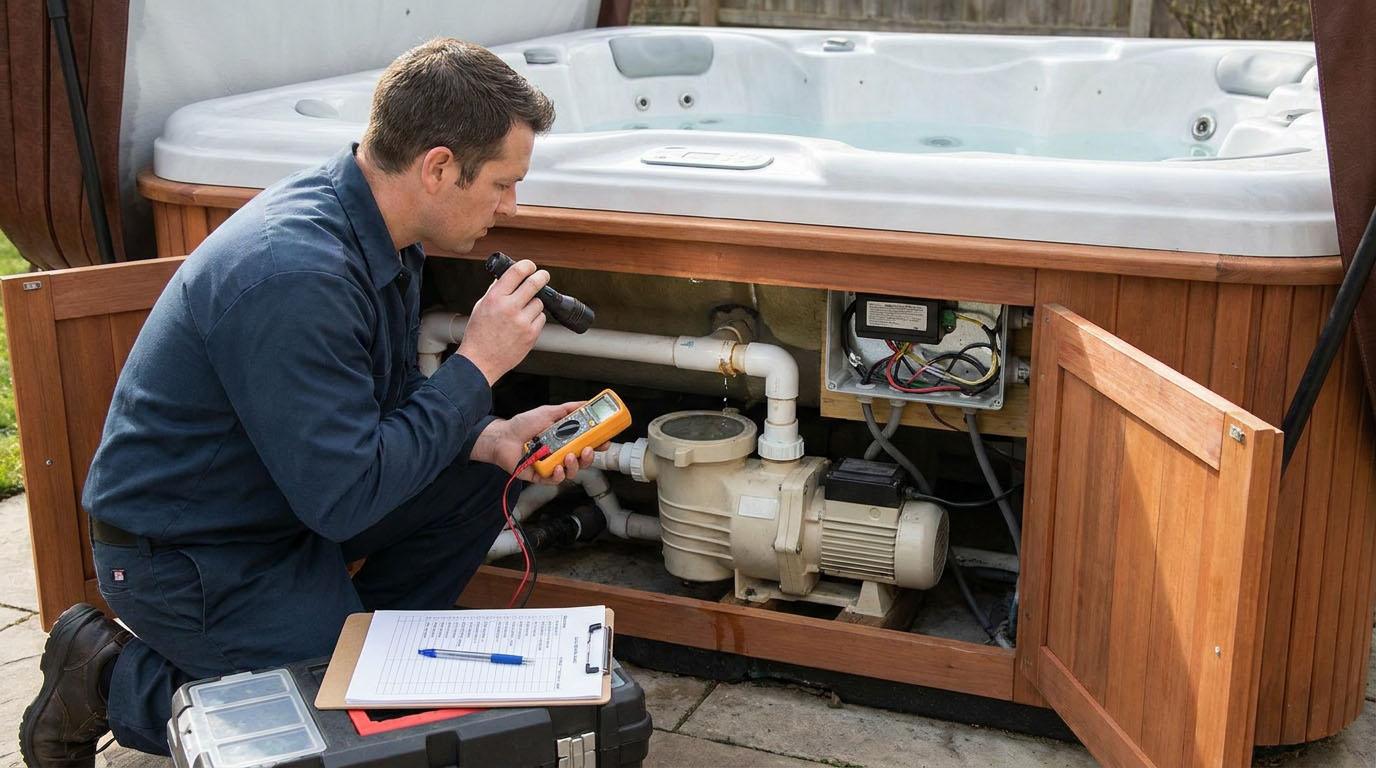
It is not enough to switch the spa on and see whether it heats. When you inspect, look and listen for:
- Pump condition and any unusual noises
- Heater performance and how long the spa takes to reach temperature
- Jets and water circulation
- The filtration system and filter condition
- The control panel and visible electrical components
- Plumbing connections and visible leaks
- The spa shell, seals and cover
- Evidence of previous repairs
There is no single reliable lifespan for every spa pump, heater or filtration system. How long equipment lasts depends on the model, how much it is used, water chemistry, the maintenance history and installation conditions. For that reason, ask for service records, installation details and warranty information, and consider an assessment from a qualified spa technician. An inspection report on the house itself may not cover the spa in detail, so check what your building inspector will and will not look at.
What Should Buyers Check About the Outdoor Installation?
The setting around the spa matters as much as the spa itself. Consider:
- Whether the base or deck supporting the filled spa appears suitable for the weight
- Drainage around the spa, particularly during heavy rain
- Access for future servicing and equipment replacement
- Exposure to sun, wind and rain
- Ventilation around equipment where required
- Electrical connections and outdoor-rated equipment
- Nearby trees, landscaping and falling debris
- Privacy, and how the area is accessed
This article does not provide structural engineering advice. If the spa sits on a deck, an elevated platform or any structure where the load capacity is uncertain, ask a suitably qualified professional to assess it. If the property is a townhouse in a complex, it is also worth checking the community’s by-laws and who is responsible for maintaining and insuring outdoor areas, since arrangements can differ between schemes.
Questions to Ask Before Buying a Property with an Outdoor Spa
Use this checklist during inspections and when speaking with the seller or agent:
- Is the spa currently operational?
- When was it installed?
- Is there an installation or purchase record?
- What type of heating system does it use?
- What are the estimated running costs?
- When was it last serviced?
- Are the pump, heater and filtration system working properly?
- Are there any known leaks or previous repairs?
- Are maintenance and servicing records available?
- Does the spa comply with applicable Queensland pool safety requirements?
- Is there a current pool safety certificate where required?
- Is the electrical installation safe and compliant?
- Is the spa cover in good condition?
- Are there any upcoming repairs or replacement costs?
If the spa’s condition or compliance is uncertain, seek professional advice before committing to the purchase.
Is a Property with an Outdoor Spa Right for You?
An outdoor spa may suit buyers who will use it regularly and are comfortable managing its maintenance and running costs. For buyers who prefer minimal upkeep, the extra work and expense may outweigh the enjoyment, and some buyers may be happier with a property where the outdoor space needs less care.
The most useful way to approach buying a property with an outdoor spa is to assess the spa as part of the entire property rather than as an isolated lifestyle feature. Look at the home, the location, the budget and the ongoing responsibilities together. If you would like help weighing up a property, you can learn more about our property buying services on the Gold Coast.
This article is general information only and is not legal, electrical, engineering or financial advice.
References
- Queensland Government, Pool fencing and safety laws
- Queensland Government, Portable and indoor pools and spas
- Queensland Building and Construction Commission, Before you buy and sell
- Queensland Electrical Safety Office, Electricity around water
- WorkSafe Queensland, Strengthening electrical safety in Queensland’s pools, spas and baths
- Government of South Australia, Swimming pools and spas
- SA Health, Private spa pools: a maintenance guide for owners