

Walk through enough open homes on sloping land and you will notice a pattern. The flat backyard sits behind a wall. The driveway is cut into the hill. The front garden steps up in terraces. Retaining walls do a lot of quiet work on these blocks, and they are easy to overlook because they tend to blend into the landscaping.
If you are buying a property with a retaining wall, the question is not only whether it looks tidy. It is what the wall is holding back, how it was built, how water is managed behind it and who is responsible for it. This guide covers what to look for, what you can reasonably check yourself and when it is worth bringing in a professional.
A retaining wall should not automatically put you off a property. Most are doing exactly what they were built to do. The aim is to understand it before you commit.
What Is a Retaining Wall and Why Is It Used?
A retaining wall holds back soil or rock. Moreton Bay Regional Council describes it as a structure designed to prevent erosion and create usable land on slopes or uneven ground, and notes that retaining walls are classed as Class 10b structures under the National Construction Code.
On residential blocks, they are commonly used to:
- create a level building pad or backyard on a sloping block
- manage the difference in ground level between neighbouring properties
- support a driveway, path or paved area cut into or built up from the slope
- form garden terraces and stepped outdoor areas
The soil behind a wall is heavy, and when it is wet it pushes harder against the wall. That is why the way a wall is designed, built and drained matters just as much as how it looks.
Why Are Retaining Walls Common on Gold Coast Properties?
Parts of the Gold Coast, particularly hillside and hinterland areas, are built on sloping land. Where a block falls away, builders and landscapers often cut into the slope, fill low areas or terrace the site so the house, driveway and yard can sit on level ground. Retaining walls make that possible.
Sloping blocks also tend to produce particular home designs, such as stepped layouts and multi-level homes, which can mean several walls on one property. Some of them may be at the front, some at the back and some along the boundary.
Council keeps mapping of where land is more susceptible to landslides. City of Gold Coast notes that landslides tend to occur on steep and unstable slopes, and that rainfall, earthworks and the failure of structures such as retaining walls can trigger them. That does not mean any particular wall is a concern. It does show why the condition of a wall on a slope is worth understanding.
We have not quoted figures on how many local properties have retaining walls or how often problems occur, because we could not find reliable data. Every wall needs to be judged on its own merits.
Types of Retaining Walls You May Encounter
Walls are built from different materials, and each has its own maintenance and durability considerations.
- Concrete: poured walls, or panels and sleepers made of concrete. These are often used for taller or heavily loaded walls, and they are usually engineered.
- Block or masonry: concrete block or brick walls, usually with reinforcement and footings. Cracking and movement can show in the mortar joints or blockwork.
- Timber: sleepers fixed between posts. They are common in gardens and can look attractive, but timber is affected by moisture and termites over time if it is not suitably treated and maintained.
- Segmental: interlocking blocks stacked in rows. They rely on correct installation and good drainage behind the wall.
- Other systems: rock or boulder walls, gabion baskets (wire cages filled with stone) and steel post-and-panel systems are also used.
No material is automatically better. A well-built, well-drained timber wall can outperform a poorly built concrete one. What matters is the design, the quality of construction, the drainage and the maintenance, along with the wall’s height and what it supports.
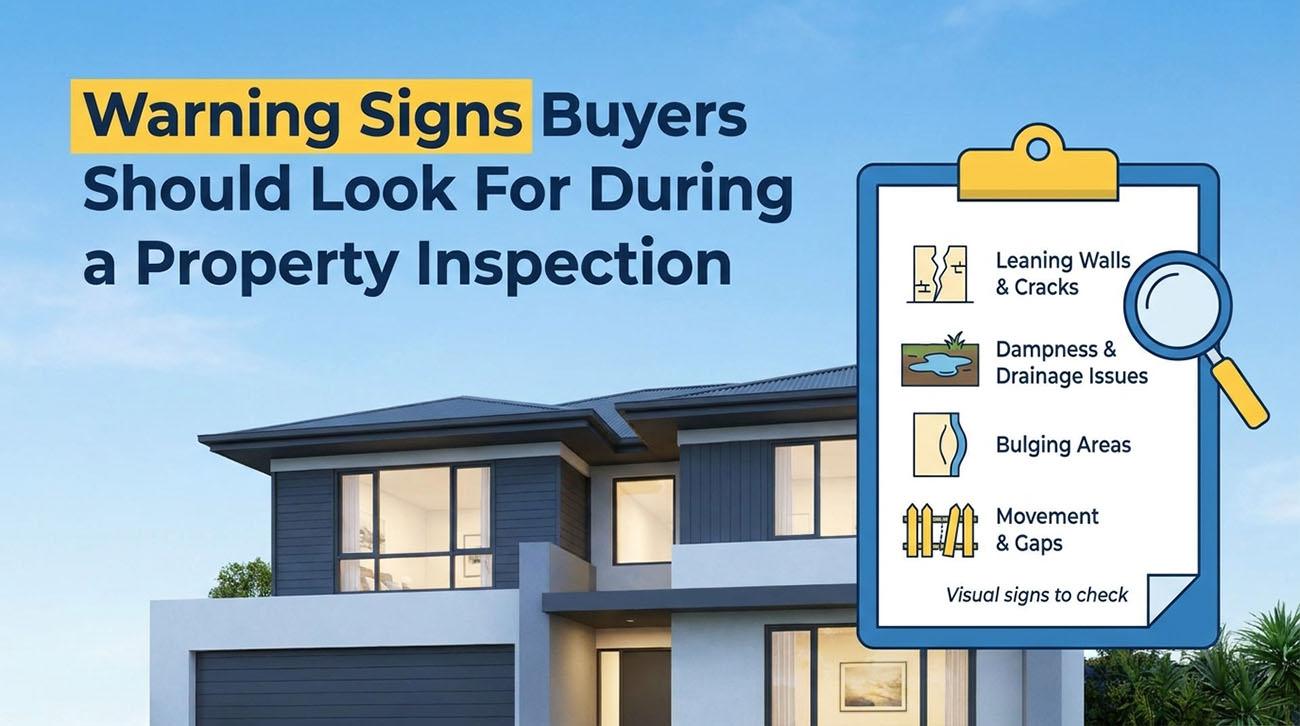
Warning Signs Buyers Should Look For During a Property Inspection
You do not need to be an engineer to notice that something looks off. These are visual signs that may justify a closer look:
- a wall that leans or bows outward
- cracks, especially wide ones, ones that are growing or ones where one side has shifted relative to the other
- movement or gaps between wall sections
- bulging areas
- soil that has slumped, sunk or moved near the wall
- damp patches, seepage or staining, or ground that stays wet
- pooling water at the base or water running over the top
- erosion at the base, or soil washing through gaps
- unusual gaps between the wall and nearby structures such as steps, sheds or fences
- fences, paving or landscaping near the wall that have shifted or tilted
A few things are worth keeping in mind. A visible warning sign does not confirm structural failure. A hairline crack, for example, might be cosmetic, while a wide or widening crack deserves a professional opinion. The reverse is also true. A wall with no visible damage is not necessarily sound, because footings, reinforcement and drainage cannot be seen from the surface.
Landscaping can hide problems as well. Garden beds, climbing plants, render and fresh paint can cover up cracks or movement, so look closely at the base and top of each wall.
Why Does Drainage Matter for Retaining Walls?
Drainage is one of the most important parts of a retaining wall, and it is the part you cannot see.
When rain soaks into the soil behind a wall, the water has to go somewhere. If it cannot escape, it builds up behind the wall, adds weight to the soil and increases the pressure on the wall. One Queensland council, Fraser Coast Regional Council, explains that most retaining walls need a subsoil drainage system behind the wall to relieve water pressure, and that a surface drain may also be needed at the top or base.
Where the water ends up matters too. City of Gold Coast says stormwater from retaining wall work must be captured and piped to the kerb or the stormwater system, and cannot be concentrated onto a neighbour’s property.
Queensland’s heavy rain and long wet spells can leave soil saturated, so a wall with poor drainage will be tested harder. Signs that water may not be managed well include:
- downpipes or stormwater discharging close to the wall or the slope above it
- water pooling at the base of the wall after rain
- a wall with no visible weep holes or outlets and no sign of a drain pipe (some drainage is buried, so ask)
- weep holes that are blocked by soil or plants
- staining, mineral deposits or soil marks on the wall face
- soil washing out through gaps or cracks
If you can, see the property after heavy rain, or ask for photos from a wet period. If the land is also in a flood zone, water management on the whole site deserves extra attention.
What Should You Check Before Buying a Property with a Retaining Wall?
Think of this as three layers: what you can see, what you can ask for and what needs an expert.
What you can observe yourself
- the overall condition of each wall, using the warning signs above
- whether the wall supports anything on top, such as a driveway, shed, pool, house or fence
- how close the wall is to the house, the boundary and neighbouring structures
- where roof water and surface water go
- whether walls are hidden behind plants or garden beds
Documents and questions
- the wall’s approximate age, who built it and whether the seller has records
- any engineering drawings or certification for the wall
- building approvals and plans on record with council (more on this below)
- maintenance and repair history, including any past leaks, movement or drainage work
- whether a licensed contractor built it. In Queensland, building work above $3,300 generally needs a licensed contractor, and the QBCC explains the licensing rules
- any known disputes with neighbours, council notices or shared responsibility arrangements
What needs a professional
Judging whether a wall is structurally sound, adequately drained or built to the right standard is work for a qualified professional. Section 11 below explains who to call and when.
Do Retaining Walls Require Council Approval in Queensland?
It depends on the wall, and there is no single height that settles it. In Queensland, some building work is “accepted development” and needs no approval, while other work needs a building approval from a private building certifier. Business Queensland explains how this works under the Building Regulation 2021.
For the Gold Coast, City of Gold Coast says a retaining wall needs building approval unless it meets all of these criteria:
- it is less than 1.0 metre high
- it is further than 1.5 metres from a building or another retaining wall
- it only supports the soil behind it, with nothing above
- it is not part of pool fencing
- the combined wall and fence height is less than 2.0 metres
- it is not built over a sewer or stormwater service
- it meets structural requirements
- it is not in an easement or covenant area
- it meets earlier development conditions
- it is not in a waterfront or oceanfront setback area
Council also suggests a side boundary setback of at least 600 millimetres to avoid maintenance or ownership issues with a neighbour.
What Other Requirements Can Apply?
Other requirements can apply as well. Land mapped as susceptible to landslide is covered by a City Plan overlay, and new development there may need a geotechnical assessment by a Registered Professional Engineer of Queensland.
For buyers, this raises practical questions rather than a simple yes or no. Was the wall built with the approvals it needed? Does it match any approved plans? Has anything been added since, such as a fence, a pool or extra fill? City of Gold Coast offers building approvals searches that can show what is on record. If something does not line up, talk to your solicitor or conveyancer before you commit.
This section is general information only. Rules vary with the wall’s height, location, loads and the property’s planning conditions, and they can change. Confirm the requirements for any specific wall with council or a private building certifier.
Who Is Responsible for a Retaining Wall Between Properties?
Do not assume you know the answer from where the wall sits.
Dividing fences in Queensland are generally shared between neighbours under the Neighbourhood Disputes (Dividing Fences and Trees) Act 2011, but retaining walls are treated differently. The Queensland Government says a retaining wall usually benefits one property more than the other, so it is not normally a joint responsibility.
Councils describe it in similar terms, with some variation. Moreton Bay Regional Council says that where a wall is built on or across a boundary, the owner of the land it sits on maintains that part. Fraser Coast Regional Council says that where a wall benefits more than one property, responsibility may be shared.
A few situations are particularly worth checking:
- the wall is on or very near the boundary, and it is unclear which block it sits on
- the wall holds up your land, or your neighbour’s land
- a fence has been built on top of the wall, which adds load and can blur who is responsible for what
- repairs have been done before, with or without an agreement between neighbours
If the position is unclear, a land surveyor can confirm where the boundary is, and your solicitor or conveyancer can review the title, the plans and the contract terms before you sign. We cannot give legal advice on who owns or must pay for a particular wall, so get independent advice if there is any doubt.
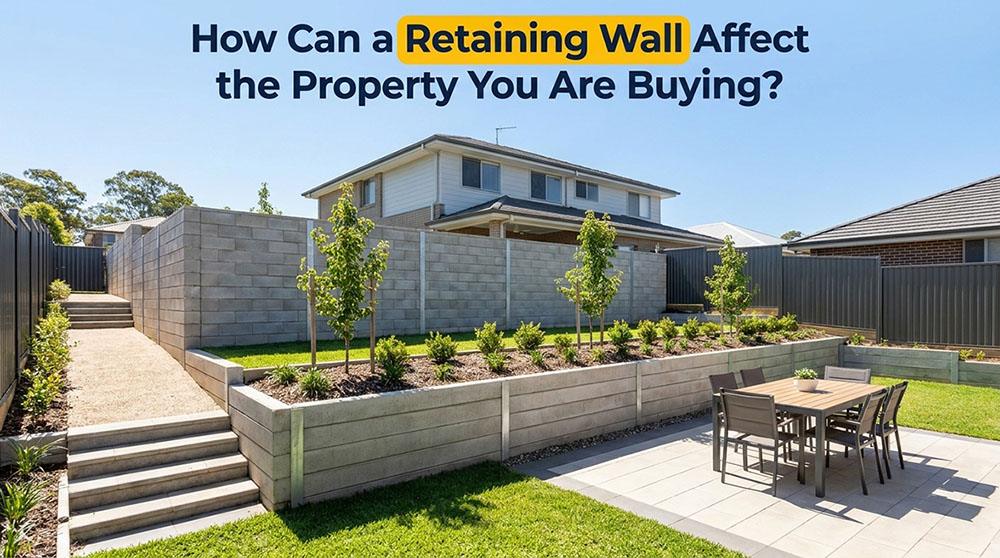
How Can a Retaining Wall Affect the Property You Are Buying?
Usable space. A well-placed wall can create a flat, usable yard from a steep block. Walls can also take up space, restrict where you can build or leave terraces that are less practical for play areas or pets.
Landscaping. Plants, garden beds and trees near a wall can affect drainage and add load, and tree roots can interfere with some wall types. Think about whether you want to change the garden.
Future renovations. Plans for a pool, extension, shed, new driveway or fence near a wall may add load or change drainage. As noted above, a wall that supports anything beyond the soil behind it may need approval, and Fraser Coast Regional Council lists adding load, adding a fence or increasing height as modifications. Check with council or a certifier before assuming something is straightforward.
Driveways and access. Walls that support or sit beside driveways, steps and paths affect safe access and can be costly to repair if they fail.
Maintenance costs. Walls need upkeep, drains need to stay clear and repairs or replacement can be significant. We have not quoted costs because they vary with the wall’s size, material and condition. If you want a lower-maintenance home, our guide to a low-maintenance property is a useful companion read.
Value and buyer perception. A well-built wall with good documentation may give future buyers confidence, while a wall with unanswered questions may lead to negotiation or hesitation. We cannot say how a particular wall will affect value, so treat that as a question for your own research and advice.
When Should You Get a Professional Inspection?
A standard building inspection is a visual assessment, and it does not replace an engineer’s report. The RACV notes that pre-purchase inspections are visual and have limits. Ask your inspector in writing which retaining walls they will cover and what is excluded. Our article on building and pest inspections gives more background on what they involve.
You might need:
- A building inspector: for the general condition of the property and the walls they can see, and for a recommendation if further assessment is needed.
- A structural engineer: if a wall is tall, holds up a house, driveway or pool, shows movement, or has no documentation. In Queensland, professional engineering services must be provided by a Registered Professional Engineer of Queensland (RPEQ) or someone directly supervised by one. You can check registration in the RPEQ directory.
- A geotechnical engineer: if there are concerns about slope stability or the land is mapped as susceptible to landslide.
- A drainage professional: such as a licensed plumber or drainer, if stormwater or subsoil drainage looks inadequate.
- A surveyor: if the wall is on or near a boundary and the position is unclear.
- A solicitor or conveyancer: for the contract, title, approvals and any responsibility questions.
Timing matters. Ask your conveyancer how to build inspections into your contract conditions, so you can get advice before you are locked in.
A Practical Retaining Wall Checklist for Property Buyers
Take this with you to inspections. It is a prompt list of observations and questions rather than a technical assessment.
- How many retaining walls are there, and how tall are they?
- Does any wall lean, bow, bulge or show wide or growing cracks?
- Are there gaps or movement between sections?
- Is there soil slumping or erosion near the wall?
- Is there damp, seepage, staining or pooling water at the base?
- Can you see weep holes, drains or outlets, and do they look clear?
- Where do downpipes and surface water discharge?
- What does the wall support: a house, driveway, pool, shed or fence?
- Has anything nearby, such as paving, fences or steps, shifted or tilted?
- Is the wall close to a boundary, and is it clear which property it sits on?
- Does the seller have plans, engineering details, approvals or repair records?
- Do you plan any changes that could affect the wall, such as a pool, extension or new driveway?
Final Thoughts
A retaining wall should not automatically discourage you from buying. On a sloping block, it is often what makes the home and yard work in the first place. What matters is understanding the wall’s condition, purpose, drainage, documentation and likely maintenance before you decide.
Look past appearances. Check how water is handled, ask for the paperwork, be clear on who is responsible and bring in the right professionals when something needs expert assessment. This article is general information and not engineering, legal or building advice.
If you are at the start of your search, our buying property page outlines the steps, you can browse current properties for sale, and our Gold Coast suburb profiles are a good way to get to know an area.